
Hybrid laser welding combines a powerful laser beam with traditional arc welding in one process. This combination welds metal 3-5 times faster than regular welding methods while creating stronger joints. The process works on thick materials (up to 15mm) without special preparation, making it popular in car manufacturing, shipbuilding, and other industries where speed and quality matter.
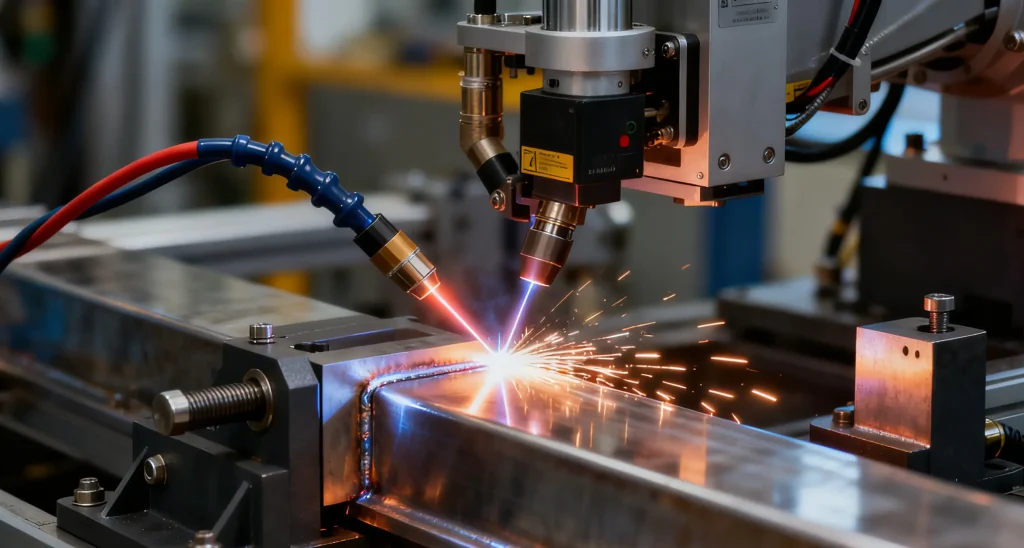
Why Hybrid Laser Welding Works Better
When you combine a laser with arc welding, you get better results than using either method alone. The laser creates a deep hole in the metal with intense heat, while the arc adds extra metal to fill gaps and strengthen the joint. This teamwork means you can weld faster, handle thicker materials, and get stronger results with less warping.
Comparison with Traditional Welding Methods
| Parameter | Hybrid Laser Welding | GMAW (MIG/MAG) | FCAW |
|---|---|---|---|
| Welding Speed | 2-10 m/min | 0.5-2 m/min | 0.8-2.5 m/min |
| Penetration Depth | 6-15 mm (single pass) | 3-5 mm | 4-6 mm |
| Heat Input | 0.3-0.8 kJ/mm | 1.5-3 kJ/mm | 1.2-2.5 kJ/mm |
| Gap Tolerance | 0.5-1.5 mm | 1-3 mm | 1-2 mm |
| Material Thickness | Up to 25 mm | Up to 12 mm | Up to 15 mm |
| Distortion Risk | Low | Medium-High | Medium |
How Hybrid Laser Welding Works
The process starts with a laser beam hitting the metal surface. The laser gets so hot (over 3,000°C) that it actually vaporizes part of the metal and creates a deep channel. This channel lets the laser energy go deep into the material for a strong weld.
Right behind the laser, an arc welder adds melted metal to fill the joint. The combination prevents bubbles and cracks while using 30-40% less total heat than regular welding. Less heat means the metal doesn’t bend or warp as much.
Main Benefits
- Goes Deeper: The laser can penetrate 6-15mm deep in one pass without needing to grind or shape the joint edges first. This saves preparation time and makes stronger welds than traditional methods.
- Works Faster: You can weld 3-5 times faster than with regular arc welding alone. Car factories have cut their assembly time by 40-60% using this method.
- Less Warping: Because the laser focuses heat in a tiny spot, there’s less overall heating of the metal. This means parts stay straighter and don’t distort as much.
- Better Gap Tolerance: Unlike laser-only welding that needs perfect fit-up, hybrid welding handles gaps up to 1.5mm. This makes it more practical for real factory conditions where parts aren’t always perfect.
- Stronger Welds: The finished welds are as strong or stronger than the base metal, with 20-30% better resistance to cracking from repeated stress. This matters for safety-critical parts like car frames and aircraft structures.
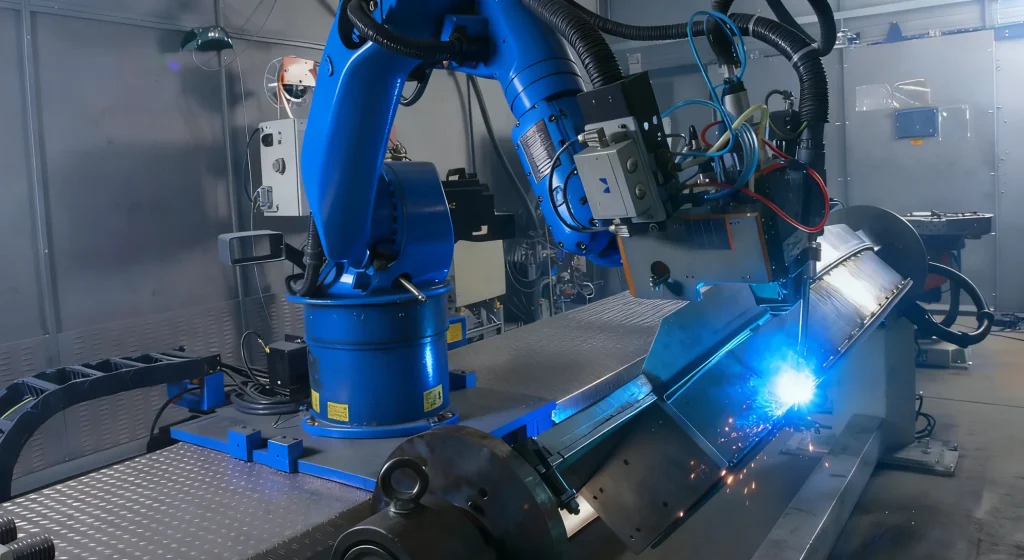
Types of Hybrid Laser Welding
You can combine laser welding with different types of arc welding processes, with each combination offering specific advantages for particular applications and materials.
Laser-MIG Welding
This is the most common type, combining lasers with MIG (wire-feed) welding. It’s the workhorse of the industry, making up over 75% of hybrid welding systems worldwide.
- Welds steel at 3-8 m/min and aluminum at 2-5 m/min
- Produces 60-80% less spatter (flying sparks) than regular MIG
- Works great on car body steel and aluminum from 2mm to 15mm thick
Laser-Plasma Welding
Uses super-heated gas along with the laser for extra precise heat control. This works especially well for thin materials (under 3mm) and tricky metals like titanium.
- Gives you precise control over heating
- Perfect for aerospace metals and reactive materials
- Creates very narrow heat zones that don’t damage surrounding metal
Laser-MAG Welding
Uses active gases like CO₂ that help clean the metal while welding. This is ideal for steel work, especially shipbuilding.
- CO₂ gas helps the weld go deeper and stay more stable
- Works on steel from 4mm to 20mm thick
- Commonly used for building ship hulls and offshore platforms
Laser-TIG Welding
Combines lasers with TIG welding to make very clean, attractive welds. Best for visible joints where appearance matters.
- Makes exceptionally neat welds with smooth surfaces
- Ideal for thin stainless steel and aluminum (0.5-4mm)
- 2-4 times faster than regular TIG welding
Where Hybrid Laser Welding is Used
- Car Manufacturing: Automakers use hybrid welding to join body panels, door frames, and chassis parts. It lets them mix steel and aluminum in the same car for better fuel economy and crash safety. Companies report 40-60% faster assembly and 25-35% stronger joints compared to old methods.
- Aerospace: Aircraft makers need perfect welds for safety. They use hybrid welding on fuselage panels, wing parts, and engine mounts made from aluminum and titanium. The low heat prevents warping on thin aircraft skins and keeps the metal strong.
- Shipbuilding: Shipyards weld thick steel plates (8-15mm) for hull construction. One pass with hybrid welding replaces 3-5 passes with old methods, cutting welding time by 50-70%. The welds handle rough ocean conditions and last for decades.
- Railway Cars: Train manufacturers weld stainless steel and aluminum car bodies. The smooth welds don’t need grinding or polishing afterward, saving 60-80% of finishing work. High-speed rail companies especially value this for lightweight train designs.
- Medical Devices: Medical equipment makers need ultra-clean welds on surgical tools and implants. Hybrid welding joins stainless steel and titanium with minimal heat, keeping the materials safe for use inside the body.
- Pipelines: Oil and gas pipeline builders use hybrid welding for large-diameter pipes. They can weld 2-4 times faster than conventional methods, speeding up construction on long pipeline projects.

Bottom Line
Hybrid laser welding combines the best parts of laser and arc welding to create faster, deeper, and more reliable joints than either method alone. It welds 3-5 times faster with 30-40% less heat, making it essential for modern manufacturing.
The technology is growing fast—the market is worth $13 billion in 2025 and expected to more than double by 2033. As lasers get more powerful and sophisticated, hybrid welding will handle even thicker materials and more applications across industries.
FAQs
Regular laser welding uses only a laser beam and requires very tight gaps (under 0.3mm) between parts. Hybrid adds an arc welder to the laser, which handles bigger gaps (up to 1.5mm), goes deeper, and is more forgiving when parts don’t fit perfectly.
Car manufacturing is #1, followed by shipbuilding, train manufacturing, and aerospace. Medical device and pipeline companies also use it for specialized applications.
Most commonly argon mixed with 20-25% CO₂ for steel welding. Pure CO₂ works for deep steel welds, while pure argon is used for aluminum and titanium.
Yes, it works well for steel-to-aluminum, stainless-to-carbon steel, and other combinations by controlling the heat and filler metal carefully. This is valuable in cars where steel frames connect to aluminum body panels.
The sweet spot is 3mm to 15mm in one pass. Thinner materials don’t really need the hybrid process, while thicker materials (up to 25mm) need more powerful lasers or multiple passes.