
< img height="1" width="1" style="display:none" src="https://www.facebook.com/tr?id=1029820091747592&ev=PageView&noscript=1" /> Mechanical Manufacturing

laser solutions for mechanical manufacturing

Mechanical Manufacturing

Discussion on the application of laser processing technology in engineering machinery manufacturing

I. Principles and Characteristics of Laser Processing Technology

1.1 The basic principle of laser processing technology

Laser processing technology is the use of high power density laser beam on the material processing methods. Its principle is to realize the melting, vaporization or formation of heat-affected zone of the material through the interaction between the laser and the material. Laser processing technology has the characteristics of non-contact, high precision, high speed and strong flexibility, which can realize the processing of complex shapes and reduce the heat influence and deformation of materials. In the field of engineering machinery manufacturing, the application of laser processing technology can significantly improve processing accuracy and efficiency, reduce production costs, is an indispensable high-precision frontier technology in modern manufacturing.

1.2 Main types of laser processing technology

The common types of application of laser processing technology include:
Laser cutting: occupies an important position in the processing of metal plates, with fast cutting speed and excellent cutting quality.
Laser welding: widely used in the field of precision welding, with the advantages of deep fusion, wide weld, small heat-affected zone and small deformation.
Laser marking and engraving: plays an important role in product marking and artistic creation, with high precision and non-wearing characteristics.
Laser surface hardening and laser cladding: By changing the surface properties of the material, it improves the wear resistance and corrosion resistance of the workpiece.
Each of these technologies has its own characteristics and complements the other, promoting the wide application and development of laser processing technology in engineering machinery manufacturing.

1.3 Advantages and limitations of laser processing technology

Advantage:
High processing precision and speed
Less material waste
Suitable for brittle materials and high precision requirements
Non-contact machining, reducing mechanical stress on the workpiece
Limitations:
High equipment cost
Specific requirements for operating environment
Limited processing efficiency for some materials
Laser processing process may appear high energy consumption and thermal effect control problems


2. the application direction of laser processing technology in engineering machinery manufacturing

2.1 Application direction : cutting technology

Laser cutting technology plays a vital role in engineering machinery manufacturing. This technology utilizes the high energy density laser beam to cut the material non-contact, realizing the processing effect of high precision and high speed. Compared with traditional mechanical cutting methods, laser cutting has incomparable advantages such as small heat-affected zone, less processing deformation, wide material adaptability and more flexible processing path design. Laser cutting technology is widely used in the processing of thick plates and special shaped parts. Engineering machinery usually requires structural parts with high strength and rigidity, laser cutting can be based on the design drawings to cut accurately, to ensure that the geometric dimensions of the parts and precision requirements, improve the performance and reliability of the whole machine, and at the same time to achieve complex shapes of one-time molding, simplify the processing procedures, shorten the production cycle, and reduce the cost of manufacturing. However, laser cutting technology also faces some challenges in the application process, such as the cutting efficiency and quality of highly reflective materials (e.g. copper and aluminum) may be affected, the laser cutting equipment and operating costs are high, and the technical level of the operator is also required to be high.

2.2 Application Direction : Welding Technology

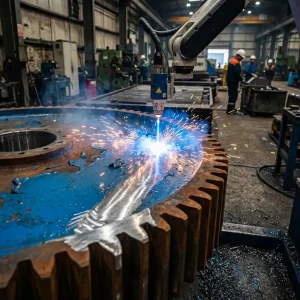
As an advanced joining process, laser welding technology realizes the melting and solidification of materials through the high temperature generated by the focused laser beam to form a weld seam. It has significant features such as deep melting, wide weld seam, small heat-affected zone, fast welding speed and small deformation, which makes it play a key role in improving the connection strength and overall performance of engineering machinery structural parts. Laser welding technology is widely used in high-strength steel, aluminum alloy and other materials connection. The working environment of construction machinery is complex and changeable, the strength and durability of structural components have very high requirements, laser welding technology can provide high-quality welds, improve the mechanical properties of welded joints, to meet the reliability requirements of construction machinery in harsh working conditions.
The high automation and intelligence level of laser welding technology provides higher productivity and lower labor cost for engineering machinery manufacturing. Through precise control of welding parameters, laser welding can carry out welding operations in complex shapes and hard-to-reach areas, solving problems that are difficult to overcome by traditional welding methods. However, laser welding technology also has certain limitations in practical application. It has strict requirements for the operating environment and material surface quality, and is highly sensitive to welding parameters, which need to be precisely controlled to avoid welding defects.

2.3 Application direction : surface treatment technology

Laser surface treatment technology is a key technology in the field of engineering machinery manufacturing. By irradiating the material surface with a laser beam, the surface properties of the material can be improved, including laser hardening, laser cladding and laser alloying, which significantly improves the abrasion resistance, corrosion resistance and fatigue strength of the material surface without changing the nature of the material matrix. In the field of construction machinery, the working environment is usually harsh, and the durability and reliability of the parts are required to be extremely high. The application of laser surface treatment technology can effectively extend the service life of mechanical parts and reduce maintenance costs.

3. the development trend and challenges of laser processing technology in engineering machinery manufacturing

With the rise of intelligent manufacturing and the demand for sustainable development, the application of laser processing technology in the engineering machinery manufacturing industry is becoming more and more promising. Laser processing technology will pay more attention to the development direction of high efficiency, high precision and intelligence. The research and development of high-power laser will significantly improve the speed and quality of cutting and welding, and the advancement of laser micromachining technology will also meet the demand for high-precision parts. Through the integration of computer-aided design and artificial intelligence algorithms, the laser processing process will achieve a higher level of automation and intelligence.

However, the development of laser processing technology also faces many challenges. High equipment costs, high operating skill requirements and in-depth understanding of material properties are factors that limit its widespread use. Thermal effects, deformation control and stability of processing accuracy during laser processing are also technical issues that need to be addressed. Researchers need to strengthen basic research, optimize process parameters, develop new laser processing equipment, and train professionals to promote the widespread application and in-depth development of laser processing technology in engineering machinery manufacturing. Through continuous technological innovation and process improvement, laser processing technology is expected to play a more critical role in enhancing the performance of engineering machinery, reducing production costs and promoting the green transformation of the manufacturing industry.

Conclusion

Laser processing technology has become an indispensable key tool in modern engineering machinery manufacturing. Its advantages in precision, speed and flexibility are changing the way complex mechanical parts are produced. Despite some limitations, the continued development of laser processing technology will support future innovations, reduce production costs, and promote more sustainable manufacturing practices.

Share:

More Posts

laser paint removal machine

Laser Cleaning for Industrial Paint Removal: Full Guide (2026)

In the evolving landscape of industrial maintenance, the demand for more efficient, sustainable, and precise surface preparation has never been higher. Traditionally, industries have relied on chemical stripping, abrasive sandblasting, or manual grinding to remove stubborn industrial coatings. However, as we move into 2026, these methods are increasingly falling out of favor due to environmental
How Does a Fiber Laser Welder Work? The Science Explained (2026 Guide)

The industrial landscape is undergoing a massive transformation, driven by the rapid evolution of laser technology. Among the most revolutionary tools in modern manufacturing is the fiber laser welder. As industries strive for greater precision, faster production cycles, and reduced operational costs, the question often arises: how does a fiber laser welder work? In this
Laser Cleaning vs Sandblasting: Which Is Better? (2026 Comparison Guide)

In the evolving landscape of industrial surface preparation, the battle between traditional methods and emerging technologies has never been more intense. For decades, sandblasting (abrasive blasting) was the undisputed king of rust removal and surface cleaning. However, as we move through 2026, the industrial sector is witnessing a paradigm shift. Sustainability, precision, and operational efficiency
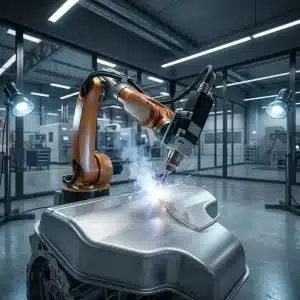
How to Laser Weld Aluminum: Parameters, Tips and Common Errors (2026 Guide)

As we move through 2026, the industrial landscape continues to demand lighter, stronger, and more efficient manufacturing processes. Aluminum has long been the darling of the automotive, aerospace, and renewable energy sectors due to its exceptional strength-to-weight ratio and corrosion resistance. However, for many years, welding aluminum was considered a “dark art” reserved for the
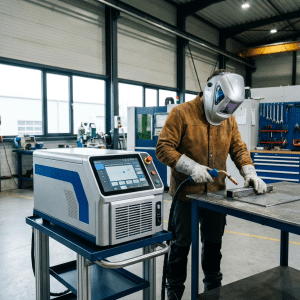
Laser Welding Machine Price Guide 2026: 1000W to 3000W

# Laser Welding Machine Price Guide 2026: 1000W to 3000W In the world of modern metal fabrication, the question is no longer whether to adopt laser technology, but when. As we navigate through 2026, the **laser welding machine price** has reached a tipping point where even small to medium-sized workshops can justify the investment based

Contact Us

Scroll to Top

Contact us

We will reach out to you within 24 hours at the email address you provided. Please keep an eye on your inbox.