
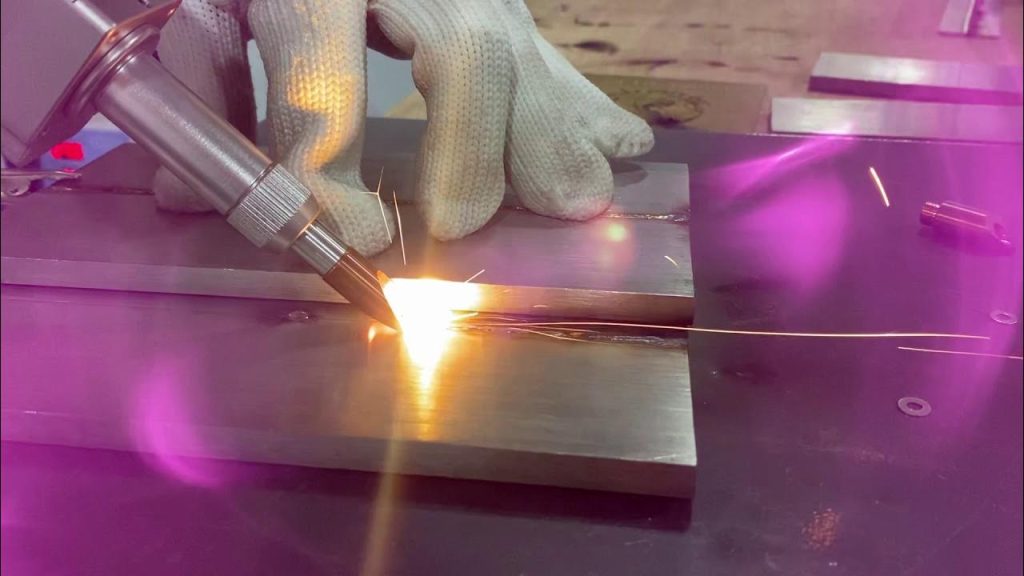
Fiber laser welding is rapidly transforming manufacturing processes across various industries, offering unparalleled precision, speed, and quality in joining materials. If you’re looking to enhance your production capabilities, understanding this advanced technology is crucial. This guide will walk you through everything you need to know about fiber laser welding, from its basic principles to its sophisticated applications.
What Is Fiber Laser Welding?
At its core, fiber laser welding is a cutting-edge process that uses a high-intensity laser beam, generated within an optical fiber, to melt and fuse materials together. Think of it like a highly focused and powerful beam of light that can create strong, precise joints in metals and even some plastics. This technique is favored for its ability to deliver concentrated heat to a very small area, resulting in minimal impact on the surrounding material. A fiber laser welder or fiber laser welding machine is the equipment used to perform this process.
Advantages of Fiber Laser Welding
Why are so many businesses adopting fiber laser welding systems? The benefits are compelling:
High Precision and Accuracy
Fiber lasers produce a very fine beam, allowing for incredibly precise welds. This means you can join intricate parts with tight tolerances, something difficult to achieve with traditional methods.
Excellent Weld Quality and Strength
The focused heat input results in deep, narrow welds with a small heat-affected zone (HAZ). This leads to stronger, cleaner welds that often require no post-processing.
High Speed and Efficiency
Fiber laser welding machines are fast. The high power density allows for rapid melting and solidification, significantly speeding up production cycles compared to older techniques.
Reduced Heat Input and Distortion
Because the heat is so localized, there’s less overall heat pumped into the material. This dramatically reduces the risk of warping or distortion, especially important for delicate components.
Versatility and Material Compatibility
Fiber lasers can weld a wide array of materials, including:
- Carbon steel
- Stainless steel
- Aluminum
- Titanium
- Copper
- Dissimilar metals
Non-Contact Process
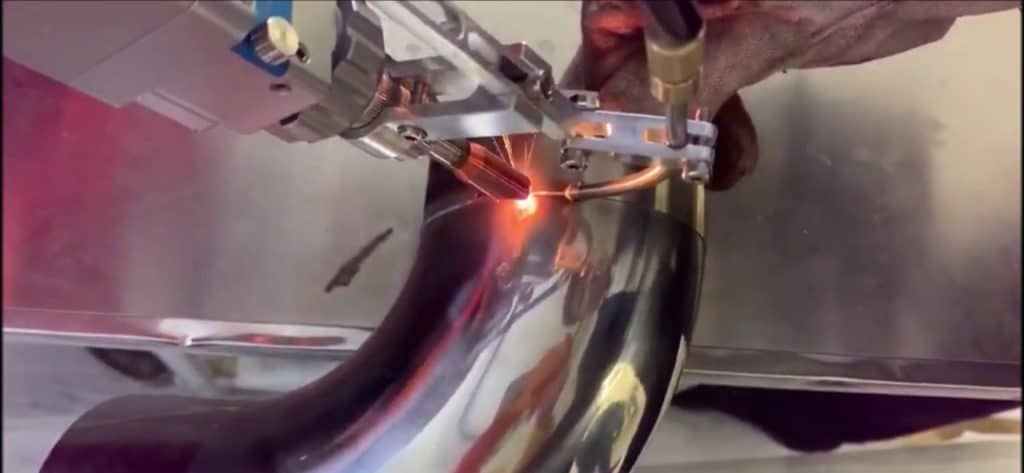
The laser head doesn’t physically touch the workpiece. This eliminates tool wear and allows for welding in hard-to-reach areas.
Low Maintenance
Fiber lasers are solid-state devices with fewer moving parts than many other laser types. This generally translates to higher reliability and lower maintenance needs for your fiber laser welder machine.
Automation Suitability
Fiber laser welding is highly compatible with robotic and CNC systems, making automatic fiber laser welding machines ideal for high-volume, repetitive tasks, ensuring consistency and efficiency.
Disadvantages and Limitations
While powerful, fiber laser welding isn’t without its challenges:
High Initial and Maintenance Costs
The initial fiber laser welding machine price can be substantial compared to traditional welding equipment. While long-term operational savings can offset this, the upfront investment is a key consideration. Replacement parts for the laser source can also be expensive.
Limited Penetration Depth for Some Applications
While capable of deep welds, for extremely thick materials (many inches), other processes might still be preferred or require very high-power fiber lasers.
High Precision Requirements
The precision of fiber laser welding is an advantage, but it also means that part fit-up needs to be very accurate. Gaps or misalignments can be more problematic than with more forgiving traditional methods.
Safety Concerns
The high-intensity laser beam poses a significant risk to the eyes and skin. Proper safety enclosures, interlocks, and personal protective equipment (PPE) are absolutely essential. Operators require specialized training.
Types of Fiber Laser Welding Processes
Understanding the different modes and waves helps in selecting the right process for your application.
Working Modes
Conduction Mode Welding
This mode is used for shallow, wide welds, often where a smooth, aesthetic finish is critical. The laser power is below the threshold that would vaporize the metal. Think of it as gently melting the surface layers.
Keyhole Mode Welding
For deeper penetration, the keyhole mode is used. The laser’s power density is high enough to vaporize the material, creating a “keyhole” of metal vapor. This allows the laser beam to penetrate deeper into the material, resulting in strong, deep welds. This is the more common mode for structural joints.
Transition Mode
This occurs between conduction and keyhole modes, offering a balance of penetration and surface finish. It requires precise control.
Laser Emission Types
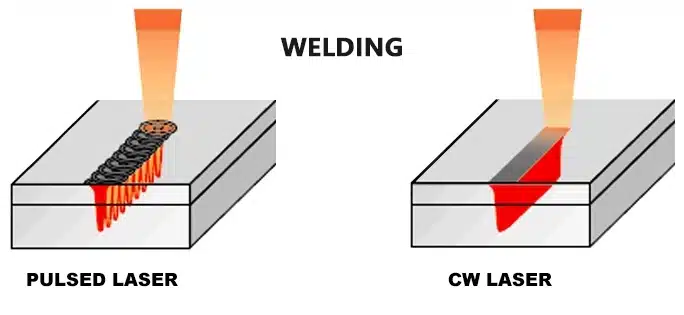
Pulsed Wave (PW) Welding
In PW welding, the laser beam is delivered in short pulses. This is excellent for delicate materials or thin sections where minimizing heat input is paramount. It allows the material to cool slightly between pulses, reducing distortion.
Continuous Wave (CW) Welding
CW welding involves a constant, uninterrupted laser beam. This is ideal for achieving high welding speeds and deep penetration on thicker materials. Most high-power fiber laser welding machines operate in CW mode for maximum productivity.
Fiber Laser Welding System Components
A complete fiber laser welding system comprises several key parts:
Laser Source
This is the heart of the system, generating the high-power laser beam. For fiber lasers, this involves diode lasers pumping an optical fiber doped with rare-earth elements like Ytterbium.
Beam Delivery System
This consists of optical fibers that transport the laser beam from the source to the welding head. These fibers are flexible, allowing for easy integration with robotics.
Welding Head
The welding head focuses the laser beam onto the workpiece. It may also include components for gas shielding, seam tracking, and process monitoring. Different heads are used for different applications, including specialized heads for 1000w handheld fiber laser welding machines.
Motion Systems
To move the welding head or the workpiece accurately, motion systems like robots, gantries, or CNC tables are used. Automatic fiber laser welding machines heavily rely on these for precision.
Control System
This system synchronizes the laser, motion system, shielding gas, and other parameters. Modern controllers offer sophisticated programming and real-time adjustments.
Monitoring Systems (Optional but Recommended)
Cameras and sensors can monitor the welding process in real-time, ensuring quality and detecting defects. This is increasingly common in advanced fiber laser welding systems.
Cooling System
High-power lasers generate significant heat, requiring an efficient cooling system (chiller) to maintain optimal operating temperatures and prolong the laser’s life.
Wire Feeder (Optional)
For applications requiring filler material to bridge gaps or modify weld metallurgy, a wire feeder can be integrated into the fiber laser welding machine.
Key Parameters Affecting Weld Quality
| Parameter | Typical Range/Values (if available) | Primary Influence On | Potential Defects if Incorrect |
| Laser Power | kW range (e.g., 0.5 kW – 200 kW demonstrated) | Penetration depth, welding speed, and melt pool size | Lack of penetration/fusion (too low), burn-through, excessive spatter, plasma effects (too high) |
| Power Density | 104−107 W/cm2 (approx. 0.5 MW/cm2 for conduction, >1.5 MW/cm2 for keyhole) | Welding mode (conduction/keyhole), penetration depth, HAZ size | Incorrect mode, insufficient/excessive penetration, spatter |
| Welding Speed | mm/s to m/min range | Heat input per unit length, penetration depth, weld width, HAZ size, productivity | Lack of penetration (too fast), burn-through, excessive distortion (too slow) |
| Focal Position (Defocus) | Typically ± a few mm from the surface | Spot size on surface, power density, penetration depth, and weld profile | Insufficient/excessive penetration, surface defects, inconsistent weld width |
| Shielding Gas Type | Argon, Helium, Nitrogen, Mixtures | Weld pool protection, plasma suppression, weld metallurgy, and weld appearance | Oxidation, porosity, embrittlement, weld instability, reduced penetration (with inappropriate gas) |
| Shielding Gas Flow Rate | L/min range (depends on nozzle, joint type) | Effectiveness of shielding, weld pool stability | Porosity, oxidation (too low), turbulence, contamination, weld instability (too high) |
| Pulse Waveform (PW) | Varied (square, ramped, etc.) | Energy coupling, heating/cooling rates, and spatter control for sensitive materials | Cracking, spatter, inconsistent melting (if not optimized for the material) |
| Pulse Width (PW) | Microseconds (µs) to Milliseconds (ms) | Heat input per pulse, melt depth, spot size, HAZ | Insufficient melting (too short), excessive heat, material removal instead of welding (too short/high peak) |
| Pulse Frequency (PW) | Hz to kHz range | Weld spot overlap (for seams), average power, heat accumulation | Discontinuous seam (too low), excessive heat, burn-through, spatter (too high for speed) |
| Beam Spot Size | Tens of µm to a few mm (depends on optics & focus) | Power density, weld width, precision | Inability to achieve the desired mode, incorrect weld dimensions |
| Fixturing / Gap Control | Gap <10-20% of thinner material thickness (e.g., <0.1mm in many cases) | Joint integrity, fusion, weld strength, consistency | Penetration depth, welding speed, and melt pool size |
Comparison with Traditional Welding Methods
How does fiber laser welding stack up against established techniques?
Fiber Laser vs. MIG/TIG Welding
- Speed: Fiber laser is significantly faster.
- Heat Input: Fiber laser has much lower heat input, reducing distortion.
- Weld Profile: Fiber laser produces narrower, deeper welds. TIG offers excellent control but is slower. MIG is faster than TIG but typically has a larger heat-affected zone than a fiber laser.
- Skill: Basic fiber laser operation (especially handheld) can be easier to learn than high-skill TIG welding.
- Cost: Fiber laser welding machine price is higher initially.
Fiber Laser vs. CO2 Laser
- Wavelength: Fiber lasers have a shorter wavelength, making them better absorbed by reflective materials like aluminum and copper.
- Efficiency: Fiber lasers are more energy-efficient.
- Maintenance: Fiber lasers generally require less maintenance (no mirrors to align/clean in the beam path like traditional CO2 lasers).
- Beam Delivery: Fiber optic delivery is more flexible than articulated arms or mirror systems for CO2 lasers.
Fiber Laser vs. Ultrasonic Bonding
- Materials: Fiber laser is primarily for metals; ultrasonic is for plastics and some thin metals.
- Mechanism: Fiber laser melts; ultrasonic uses high-frequency vibrations.
- Strength: Laser welds are typically stronger for metals.
Fiber Laser vs. Resistance Welding
- Contact: Fiber laser is non-contact; resistance welding requires electrodes to clamp the material.
- Versatility: Fiber laser offers more flexibility in joint types and complex geometries.
- Material Finish: Fiber laser generally leaves a cleaner finish with less indentation.
Conclusion
Fiber laser welding offers a powerful combination of speed, precision, and quality that is reshaping modern manufacturing. Whether you’re considering a flexible 1000w handheld fiber laser welding machine for custom jobs or a fully automatic fiber laser welding machine for high-volume production, the advantages are clear. While the initial fiber laser welding machine price requires consideration, the long-term benefits in efficiency, reduced waste, and superior product quality often provide a strong return on investment.

Ready to explore how a fiber laser welder can elevate your operations? Contact an expert today to discuss your specific application and find the perfect fiber laser welding system for your needs.
FAQs
Fiber lasers are very versatile tools! In addition to fiber laser welding, they are widely used for:
Cutting materials: Precisely cutting metals like steel, aluminum, and brass.
Marking and engraving: Adding serial numbers, logos, or designs onto parts.
Cleaning surfaces: Removing rust, paint, or contaminants.
They are also used in telecommunications and medical applications.
Fiber laser welding can produce welds that are typically as strong as, or sometimes even stronger than, traditional MIG welds. This is because laser welds are often deep and narrow with very few imperfections, leading to excellent joint integrity. The precise heat control also helps.
The initial purchase of a fiber laser welding machine can be more expensive than traditional welding equipment. However, for many businesses, it can save money in the long run. This is because fiber laser welders are faster, use less consumable material (like filler wire in some cases), produce high-quality welds that need less rework, and are well-suited for automation, leading to lower labor costs per part.
The main differences are the type of light they produce (their wavelength) and what they are best used for:
Fiber lasers (like those used in fiber laser welding) produce a wavelength that is excellent for working with metals – welding, cutting, and marking them efficiently.
UV lasers produce a much shorter wavelength of light. This makes them ideal for “cold marking” – marking materials with very little heat input. They are great for plastics, glass, organic materials, and very fine, delicate applications where heat damage is a major concern.