Laser welding technology has been widely used in modern manufacturing due to its efficient and precise welding capabilities. With the development of laser welding technology, the emergence of green laser, blue laser and dual-beam composite welding processes has further enhanced the original advantages of laser welding. These new laser welding technologies, especially when welding highly reflective metal materials such as copper, show significant advantages, not only reducing energy consumption, but also reducing spatter and defects during welding, and promoting the innovation of welding technology.
Green laser welding
Green laser is a visible light with a wavelength of 500-560nm. The absorption rate of copper to green light with a wavelength of λ=515nm is as high as 40%, which is about 8 times the absorption rate of infrared light of about 1μm, and the energy coupling efficiency is higher, and the sensitivity to surface oxidation is also reduced.
The use of green laser can significantly reduce the threshold power of copper deep melting welding, the amount of melt spray and spatter on the weld surface is small, and it is almost unaffected by the welding speed. If beam scanning, beam defocusing and correct laser power modulation are added, the welding quality can be significantly improved. The number of weld defects is greatly reduced, and the weld surface will be more regular and uniform.
Blue laser welding
The wavelength of blue laser is 400nm~500nm. The semiconductor laser based on gallium nitride material can directly generate laser with a wavelength of 450nm without further frequency doubling. It has the advantages of simple structure, easy use, electro-optical conversion efficiency and high absorption rate.
Compared with the fiber laser commonly used in industrial processing, the absorption rate of metal materials at 450nm of blue laser is increased by 10%-60%, especially for highly reflective metal materials such as copper and gold. It has been verified that the energy consumption required for copper welding is 84% lower than that of infrared laser, which means that when the infrared laser needs 10 kW of laser power to weld copper, the blue laser only needs about 1 kW or 0.5 kW of power.
So far, Riselaser has successfully developed a variety of blue light semiconductor lasers with a full range of power from 100W to 3500W, and can provide customers with customized overall solutions including key processing accessories and processing technology.
Dual-beam composite welding
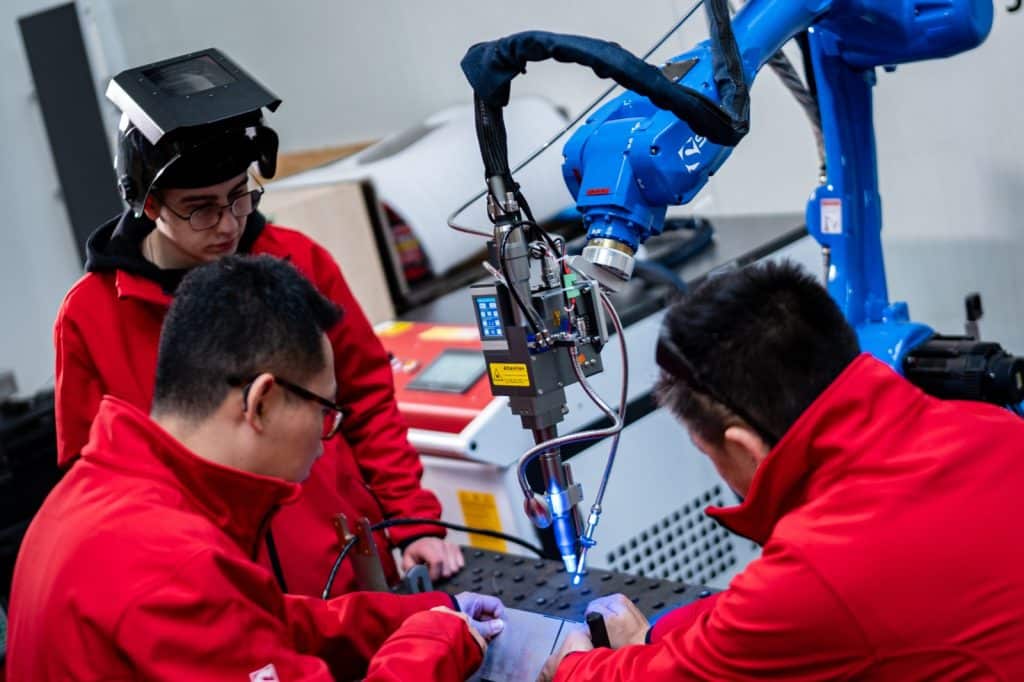
Using the infrared-visible light dual-beam composite welding process, through a relatively low-power visible light laser, the infrared laser can achieve forced deep-melting welding of copper when the power is lower than the deep-melting welding threshold, and greatly reduce welding spatter. The equipment cost is low and the welding quality is high. It is considered to have very outstanding advantages and good application prospects.
As Riselaser continues to launch innovative products and customized solutions, laser welding technology will play a more important role in the future manufacturing industry and promote the continuous development and progress of the industry.