
Welding is a critical process in many manufacturing operations. Robotic welding is a time-tested method for improving processes and comes in many different types.
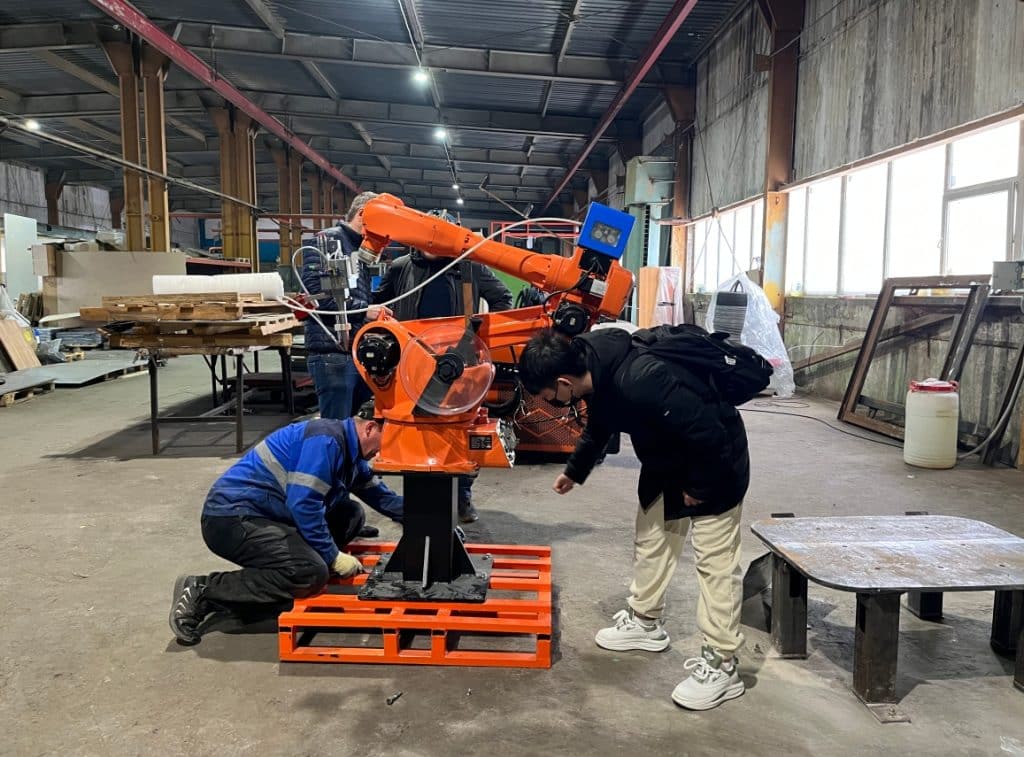
Let’s look at why we need to use robotic welding and explore some common types.
Where does robotic welding fit in?
Robotic welding has made significant advances over the years, both in terms of technology and demand. It has evolved from simple, repetitive welding tasks to complex, high-precision operations.
From the development of sophisticated robotic sensors and algorithms to easy-to-use programming options that reduce barriers to entry, robotic welding is now more accessible than ever before.
One of the big drivers for robotic welding is the skills shortage in the job market. This is becoming a major issue around the world.
Countries are implementing radical changes to address the shortage, including refocusing STEM education goals and planning for apprenticeships. However, these are long-term solutions.
Robots offer an immediate and powerful way to address the welder shortage. They help you make the most of the skilled welders you already have.
Advantages of Robotic Welding Over Manual Welding
Robotic welding offers many benefits over manual welding.
These include:
Improved weld quality – Robots can produce higher quality welds than humans because you can program the weld pattern precisely.
Safer work – Welding can be a dangerous task for workers. Using robots reduces the chances of workers getting into danger.
Flexibility – With an intuitive programming interface, you can easily reprogram the robot for any new task.
Consistent welds – Robots reproduce the same weld pattern every time, making them more consistent than human welders.
Better use of talent – If you only have a few skilled welders on your team, you can use robots to scale your welding operation with surprisingly short training times
These benefits are well worth finding out if robotic welding is right for you!
8 common types of robotic welding you might use
There are several types of robotic welding, each suitable for slightly different applications or settings.
Which one you choose will depend on your specific needs. However, you can program all of them with RoboDK.
With the right robot and programming software, you can transition to automating your welding processes even if you know little or nothing about robotics. However, there are various decisions you need to make, including the type of robotic welding you use. Off-line programming (OLP) is considered the best choice for complex, modern welding projects.
Let’s explore why robotic welding is beneficial and take a closer look at some common types.
Resistance spot welding
Resistance welding involves passing a strong electrical current through two pieces of metal. This heats and melts the metal, forging the two pieces together.
Specifically, resistance spot welding involves welding individual spots rather than a continuous weld line. You will use a spot welding tool as the robot’s end effector. Laser welding
Laser welding uses a concentrated, high-energy beam to melt and fuse materials together. This method is highly accurate and can be used to weld small, intricate parts.
Robotic laser welding is often used in industries such as electronics and medical device manufacturing.
Hybrid laser welding
Hybrid laser welding combines laser welding with arc welding. This method offers the deeper penetration of laser welding with the superior gap bridging capabilities of arc welding.
Robotic systems for hybrid laser welding are particularly useful for applications that offer high production speeds and precision.
Shielded metal arc welding (SMAW)
Shielded metal arc welding, or stick welding, uses a flux-coated electrode to form the weld. This method is known for its versatility and can be used on a wide variety of metals and alloys.
Robots using SMAW can benefit from adding image recognition capabilities to detect and repair cracks in the material. Gas Tungsten Arc Welding or Tungsten Inert Gas Welding (GTAW/TIG)
GTAW or TIG welding is a very common welding process that uses a non-consumable tungsten electrode and shielding gas to produce the weld. This method is known for producing high-quality, clean welds with excellent aesthetics.
This type of robotic welding is often used where weld quality is critical, such as aerospace and nuclear power plants. Thin-gauge arc welding
Thin-gauge arc welding is often used to weld thin sheets of metal. This can be challenging because thinner materials require a delicate approach.
When programming a robotic weld, it is best to perform additional physical tests to ensure that thin materials will not warp. Plasma welding
Plasma welding uses a constricted arc or plasma jet to melt the metal, resulting in a more focused, controlled weld. [Related to TIG welding].
In the robotic tool, an arc is formed between the tungsten electrode and the material, with plasma gas to stabilize the arc and prevent oxidation. Metal Inert or Active Gas (MIG/MAG) Welding
Finally, MIG or MAG welding is a gas metal arc welding process using a continuously fed welding wire and shielding gas.