In the evolving landscape of industrial maintenance, the demand for more efficient, sustainable, and precise surface preparation has never been higher. Traditionally, industries have relied on chemical stripping, abrasive sandblasting, or manual grinding to remove stubborn industrial coatings. However, as we move into 2026, these methods are increasingly falling out of favor due to environmental regulations, high consumable costs, and the risk of substrate damage. Enter the laser paint removal machine—a revolutionary technology that has transitioned from a niche aerospace tool to a mainstream industrial powerhouse.
Paint removal is no longer just about “getting the job done”; it is about operational efficiency, worker safety, and minimizing the environmental footprint. Whether it is stripping a multi-layered epoxy coating from a bridge or delicately removing a primer from a composite aircraft skin, laser cleaning offers a non-contact, media-free solution that traditional methods simply cannot match. In this comprehensive guide, we explore the mechanics, applications, and strategic advantages of integrating laser technology into your industrial workflow.
How Does a Laser Paint Removal Machine Work?
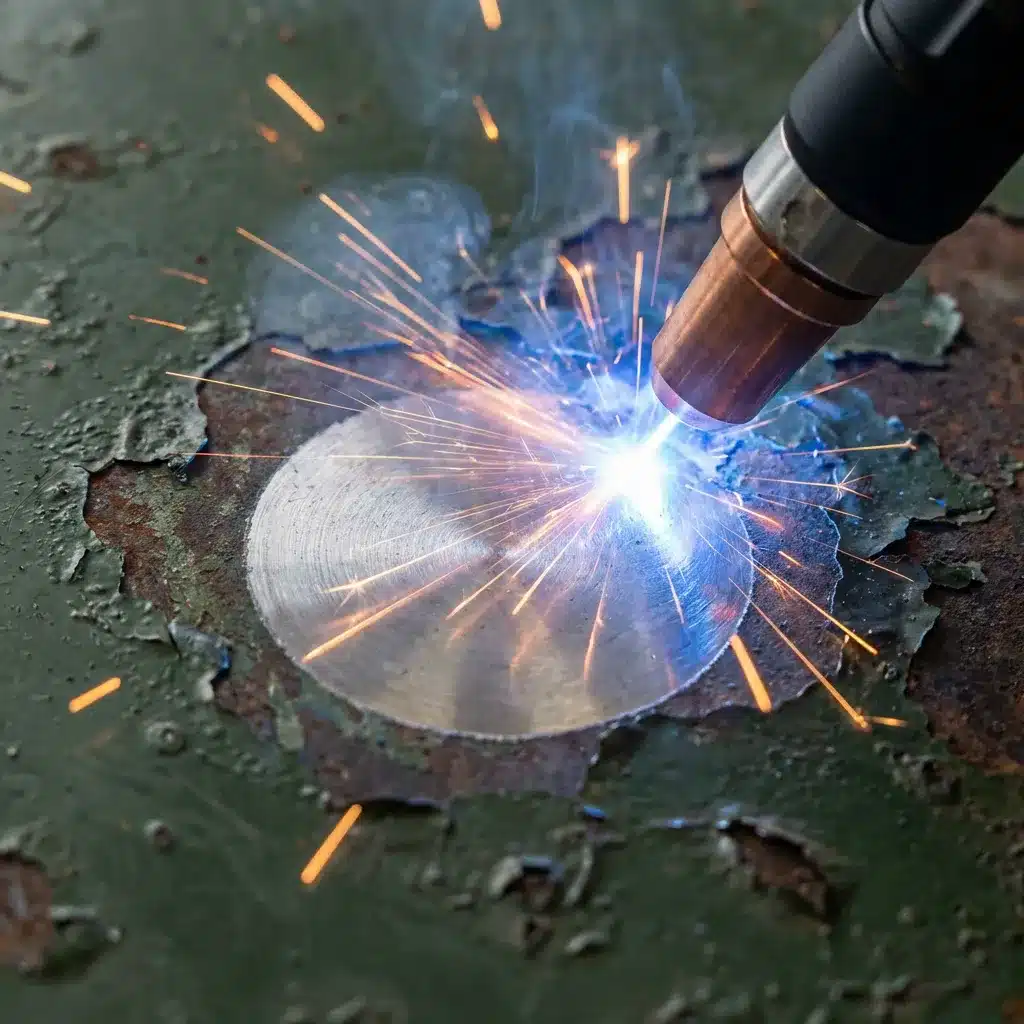
At its core, a laser paint removal machine utilizes a process known as laser ablation. Unlike mechanical methods that use friction or impact to chip away at paint, laser cleaning uses high-intensity light energy to interact with the coating at a molecular level. This process is governed by the principles of selective absorption and thermal expansion.
When the laser beam hits the surface, the paint or coating absorbs the energy of the photons. This rapid absorption causes the coating to heat up instantly. Because the energy is delivered in extremely short pulses (nanoseconds), the paint is vaporized or undergoes “cold ablation” before the heat can transfer significantly to the underlying metal or composite. This is the “selective” nature of the technology: different materials have different absorption thresholds. A properly tuned laser will vaporize the paint while being reflected by or passing harmlessly through the substrate.
To understand the deeper physics behind how these systems generate such precise energy, it is helpful to look at the underlying hardware. You can learn more about the technical foundations in our article on how fiber laser technology works, as many of the same optical principles apply to cleaning systems.
The Role of Peak Power and Pulse Duration
Modern industrial paint removal relies on nanosecond fiber lasers. These systems deliver millions of watts of peak power in a fraction of a second. This high power density creates a “plasma pressure” that breaks the chemical bonds of the paint, turning it into gas and fine particulates that are then captured by a vacuum or fume extraction system. By adjusting the scan speed, pulse frequency, and power output, operators can strip a single layer of paint without disturbing the primer beneath, or remove everything down to the bare metal.
Types of Paint and Coatings Suitable for Laser Cleaning
The versatility of a laser paint removal machine is one of its strongest selling points. In industrial environments, coatings are often engineered to be permanent and resistant to chemicals, making them notoriously difficult to remove. Laser systems excel at handling a wide variety of these tough materials:
- Epoxy Coatings: Commonly used in marine and structural steel applications, epoxies are known for their hardness. Laser ablation shatters the polymer chains of epoxy, making it easy to remove even thick layers.
- Polyurethane (PU): Often found in the automotive and aerospace sectors, PU coatings are elastic and UV-resistant. High-frequency laser pulses effectively vaporize these coatings without the “smearing” often seen with mechanical grinding.
- Powder Coatings: These are baked onto the metal and are highly resistant to traditional solvents. A laser can strip powder coatings quickly, leaving a surface that is perfectly prepped for re-coating.
- Rust-Preventive Oils and Primers: Before welding or bonding, these thin layers must be removed. Laser cleaning provides a chemically clean surface without any residue.
- Lead-Based Paint: Removing lead paint is a major health hazard with sandblasting. Laser cleaning, when paired with a HEPA-filtered extraction system, provides a safe, contained method for lead paint abatement.
Key Advantages of Using Laser for Paint Stripping
Why are global manufacturers pivoting toward the laser paint removal machine? The benefits extend beyond just “cleaning” to encompass the entire lifecycle of industrial production.
1. Extreme Precision and Selectivity
In many industries, such as aerospace or heritage restoration, you don’t always want to remove everything. Laser cleaning allows for layer-by-layer removal. An operator can remove the topcoat while leaving the protective chromate primer intact. This level of control is impossible with sandblasting or chemical baths, which are “all or nothing” processes.
2. Zero Substrate Damage
Traditional abrasives (sand, grit, beads) can cause “work hardening” or surface profile changes in metals. On sensitive materials like aluminum or carbon fiber composites, abrasives can actually thin the material, compromising structural integrity. Laser cleaning is non-abrasive; it removes the contaminant without touching the substrate, ensuring the original dimensions and properties of the part remain unchanged.
3. Environmental Sustainability (The Green Choice)
Chemical stripping produces thousands of gallons of toxic sludge that must be disposed of at a high cost. Sandblasting produces massive amounts of dust and spent media. A laser paint removal machine uses no consumables. The only “waste” is the vaporized paint, which is captured by a filter. This makes it the premier choice for companies aiming to meet ESG (Environmental, Social, and Governance) targets in 2026.
4. Operational Safety
No more splashing chemicals or high-pressure grit. Laser cleaning is a relatively quiet, controlled process. While it requires specialized eye protection, it eliminates the long-term health risks associated with inhaling silica dust or absorbing hazardous solvents through the skin.
Applications Across Industries
The industrial adoption of laser paint stripping has spanned across various sectors, each finding unique value in the technology.
Aerospace: Aircraft Skin Stripping
Maintenance, Repair, and Overhaul (MRO) facilities in the aviation sector use lasers to strip aircraft wings and fuselages. Because aircraft are often made of lightweight aluminum or composites, the “no-damage” guarantee of laser cleaning is critical. It also significantly reduces the weight of the aircraft by ensuring all old paint is removed before a new coat is applied, leading to better fuel efficiency.
Automotive: Classic Car Restoration and Manufacturing
In automotive manufacturing, lasers are used to clean E-coat (electrophoretic coating) from specific areas to ensure high-quality welds. In the restoration world, a laser paint removal machine can strip a classic car body down to bare metal in hours without the risk of warping the thin panels—a common problem with heat-inducing sandblasting.
Shipbuilding and Marine Maintenance
Hulls, ballast tanks, and offshore platforms suffer from extreme corrosion and thick anti-fouling coatings. While traditional blasting is still used for massive surface areas, high-power (2kW-3kW) lasers are increasingly used for “spot” repairs and for cleaning sensitive components like valves and propulsion systems where grit contamination would be disastrous.
Nuclear and Power Generation: Decontamination
In the nuclear industry, paint often traps radioactive particulates. Laser cleaning can vaporize the paint, and the resulting gas can be filtered, effectively decontaminating the surface. This reduces the volume of radioactive waste compared to using water or chemicals.
Choosing the Right Machine: Pulse vs. CW Laser
When investing in a laser paint removal machine, the most critical decision is choosing between a Pulsed Laser and a Continuous Wave (CW) Laser. The right choice depends on your specific application and substrate sensitivity.
| Feature | Pulse Laser Cleaning | CW (Continuous Wave) Laser |
|---|---|---|
| Heat Input | Very Low (Cold Ablation) | Higher (Thermal Interaction) |
| Substrate Safety | Best for delicate metals/composites | Best for thick, heavy steel |
| Efficiency | Higher precision, lower speed | Higher speed, lower precision |
| Price Point | Higher investment cost | More budget-friendly |
For high-precision tasks where the substrate must remain pristine, we recommend a Pulse Laser Cleaning Machine. These units are ideal for molds, aerospace parts, and sensitive automotive panels. However, if your goal is to strip thick rust or paint from heavy-duty construction steel where speed is the priority, a CW system may be more cost-effective.
For shops that need maximum versatility, the 3-in-1 laser welding cleaning cutting machine offers a multi-functional platform. While the cleaning function on a 3-in-1 is usually CW-based, it provides an incredible ROI for small-to-medium enterprises that need to switch between fabrication and maintenance tasks.
Safety Standards and PPE for Industrial Paint Stripping
Despite being a “clean” technology, a laser paint removal machine is a Class 4 laser product. This means that safety protocols are non-negotiable. Operating an industrial laser requires specific precautions to protect both the operator and bystanders.
- Laser Safety Glasses: You must use goggles rated for the specific wavelength of the laser (usually 1064nm for fiber lasers). Standard sunglasses or welding helmets will not provide protection.
- Fume Extraction: Vaporized paint contains particulates and gases that can be toxic depending on the coating’s composition. A high-efficiency fume extractor with a multi-stage filter (including HEPA and Carbon) is essential.
- Controlled Access: The cleaning area should be cordoned off with laser-safe curtains or enclosures to prevent stray reflections from reaching unprotected eyes.
- Training: Operators should be trained in “beam management”—understanding focal distance and scan patterns to maximize efficiency and safety.
ROI and Operational Efficiency Analysis
The upfront cost of a laser paint removal machine is higher than a sandblasting setup. However, a professional ROI analysis usually reveals a “break-even” point within 12 to 18 months for high-volume operations. Here is how the math works:
1. Consumable Savings: Sandblasting requires a constant supply of grit (steel shot, garnet, or glass bead) and air compressor maintenance. Laser cleaning requires only electricity (usually pennies per hour).
2. Waste Disposal Costs: Many jurisdictions charge by the pound for hazardous waste disposal. By eliminating chemical sludge and spent media, companies can save thousands of dollars annually in waste management fees.
3. Labor Reduction: Laser cleaning is often faster because there is zero “post-processing.” After sandblasting, parts must be blown off, degreased, and checked for embedded grit. With laser, the part is ready for the next stage (welding, painting, or assembly) immediately.
4. Downtime Minimization: Because it is a non-contact process, there is very little wear and tear on the machine. Most fiber lasers are rated for 100,000 hours of operation, ensuring years of reliable service with minimal maintenance.
Conclusion
The transition to laser technology for industrial paint removal is no longer a futuristic concept—it is a current necessity for competitive manufacturing and maintenance. A laser paint removal machine provides the unique trifecta of precision, safety, and environmental responsibility. By choosing the right system—whether a high-precision pulsed unit or a versatile multi-function machine—businesses can significantly reduce their operational costs while improving the quality of their surface preparation.
At Laser Scheme, we specialize in providing cutting-edge laser solutions tailored to the rigors of modern industry. From aerospace-grade pulse cleaners to heavy-duty industrial systems, our technology is designed to help you strip away the past and build a cleaner future. Ready to modernize your facility? Explore our full range of cleaning solutions and take the first step toward a more efficient, chemical-free production line.
Contact Laser Scheme today for a custom consultation and see how our laser paint removal machines can transform your business.