The laser cleaning machine has emerged as the most significant breakthrough in industrial surface preparation in decades. As industries move away from traditional, environmentally taxing methods like sandblasting and chemical stripping, laser technology offers a precise, non-contact, and eco-friendly alternative. Whether you are dealing with heavy rust on structural steel or delicate contaminants on aerospace components, understanding how this technology works and how to choose the right system is crucial for modern manufacturing and maintenance. In this comprehensive guide, we will explore the mechanics, applications, and economics of laser cleaning to help you transition to this superior surface treatment solution.
How Does a Laser Cleaning Machine Work?
At its core, laser cleaning operates on the principle of laser ablation. This process involves directing a high-intensity, focused laser beam onto a material’s surface. When the laser hits the layer of contamination—such as rust, paint, or oil—the energy is absorbed by the contaminant at an extremely high rate. This rapid energy absorption causes the temperature of the contaminant to rise instantaneously, leading to vaporization or sublimation.
A key advantage of the laser cleaning machine is its selectivity. Different materials have different thresholds for laser absorption. Most base metals, like steel or aluminum, reflect a significant portion of the laser energy at specific wavelengths, meaning they remain cool and undamaged. However, contaminants like iron oxide (rust) or organic coatings absorb the energy readily. This allows the laser to “strip” the surface without affecting the underlying substrate’s integrity. Depending on the machine type, the laser can be delivered in short, high-energy pulses or as a continuous stream, each offering distinct advantages for different industrial needs.
Pulse Laser vs Continuous Wave (CW) Laser Cleaning
Choosing between a pulse laser and a continuous wave (CW) laser is one of the most important decisions when investing in a cleaning system. Below is a detailed comparison of their characteristics:
| Feature | Pulse Laser | CW Laser |
|---|---|---|
| Peak Power | Extremely High (kW to MW) | Lower (Matches Average Power) |
| Heat Input | Very Low (Cold Process) | High (Thermal Effect) |
| Surface Damage Risk | Near Zero | Moderate (Risk of Melting/Warping) |
| Best For | Precision Parts, Molds, Aerospace | Large Steel Structures, Thick Rust |
| Typical Power Range | 100W – 500W | 1000W – 3000W |
| Price | Higher per Watt | Lower per Watt |
For applications requiring high precision and zero heat deformation, a pulse laser cleaning machine is the industry standard. Conversely, if the goal is rapid removal of thick rust from heavy structural beams where minor heat input is acceptable, CW lasers offer higher throughput at a lower price point.
What Can a Laser Cleaning Machine Remove?
The versatility of laser cleaning makes it applicable across almost every sector of heavy and light industry. Here are the most common contaminants that can be effectively removed:
- Rust and Iron Oxide: Quickly converts red and black rust into vapor, leaving a chemically clean surface ready for painting or welding.
- Mill Scale: Removes the hot-rolled scale from new steel surfaces far more efficiently than mechanical grinding.
- Paint and Industrial Coatings: Precisely strips layers of paint from machinery or vehicles without the use of toxic solvents.
- Oil and Grease: Vaporizes organic lubricants and hydrocarbons, which is essential for pre-weld preparation.
- Rubber Residue: Frequently used in tire manufacturing to clean vulcanization molds without abrasive damage.
- Weld Spatter: Cleans up debris around weld seams to ensure high-quality finishes and inspection readiness.
- Anodized Layers: Can selectively remove anodization from aluminum parts for electrical grounding or repair.
- Mold Release Agents: Ensures that composite and plastic molds remain clean and within tight tolerances for thousands of cycles.
Top Industrial Applications
The implementation of laser cleaning technology has revolutionized several key industries by increasing safety and reducing downtime:
- Automotive Industry: Used for pre-weld surface preparation on frames and removing underbody coatings during restoration.
- Aerospace: Critical for removing aluminum oxide and old paint from aircraft skins without inducing fatigue or stress in the metal.
- Shipbuilding and Marine: Essential for hull preparation and maintaining engine components in harsh, salt-heavy environments.
- Mold Cleaning: Ideal for non-abrasive cleaning of injection molds, significantly extending the life of expensive tooling.
- Heritage and Restoration: Gently removes soot and biological growth from ancient stonework and metal artifacts without losing detail.
- Food Processing Equipment: Provides a chemical-free way to deep-clean stainless steel surfaces and remove carbonized food residue.
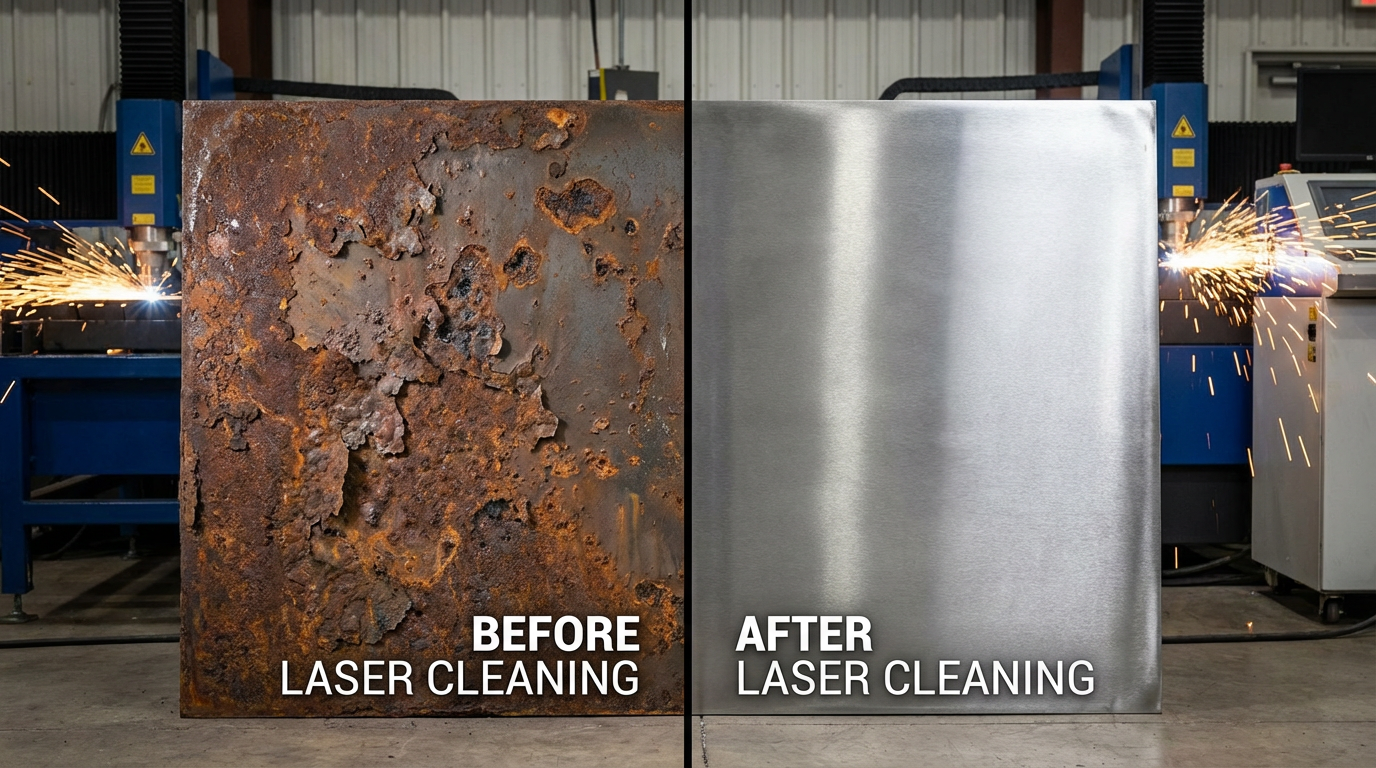
Figure 1: Side-by-side comparison of rusted steel versus laser-cleaned bare metal.
Laser Cleaning vs Sandblasting vs Chemical Stripping
When comparing surface preparation methods, laser cleaning stands out for its lack of consumables and environmental safety. The following table summarizes how it stacks up against traditional methods:
| Method | Surface Damage | Media Needed | Precision | Environmental Impact | Operational Cost |
|---|---|---|---|---|---|
| Laser Cleaning | None | None (Electricity only) | Micron-level | Zero Waste | Low (Long-term) |
| Sandblasting | High (Abrasive) | Sand/Grit/Beads | Low | High (Dust/Waste) | High (Media cost) |
| Chemical Stripping | Chemical Etching | Acids/Solvents | Moderate | Very High (Toxic) | High (Disposal cost) |
How to Choose the Right Laser Cleaning Power
The “wattage” of your laser determines how much energy is delivered to the surface and how fast you can work. Choosing the right power level is essential for balancing efficiency with your budget.
- 100W Laser Cleaning Machine: Best suited for light rust, thin coatings, and delicate surface cleaning. It is often used in heritage restoration or precision electronic cleaning where material removal must be minimal and extremely controlled.
- 200W – 300W Laser Cleaning Machine: The “sweet spot” for many general workshops. It can handle moderate rust, multiple layers of paint, and oil removal with good speed. It is common in automotive repair and small-scale manufacturing.
- 500W Laser Cleaning Machine: A high-power pulse system designed for industrial production lines. It excels at removing heavy mill scale and thick industrial coatings at a rate that keeps up with factory throughput requirements.
- 1000W – 3000W CW Laser Cleaning: These ultra-high power systems are built for the heaviest industrial tasks, such as cleaning large ship hulls, bridge components, or massive steel structures. While they generate more heat, their speed is unmatched for large-area coverage.
Laser Cleaning Machine Price Guide 2026
As the technology matures, prices have become more accessible for small and medium-sized enterprises. Here is an estimate of current market pricing for high-quality industrial systems:
| Power | Type | Price Range (USD) | Best For |
|---|---|---|---|
| 100W | Pulse | $5,000 – $8,000 | Fine Art, Precision Electronics |
| 200W | Pulse | $9,000 – $14,000 | Auto Restoration, Tooling |
| 1500W | CW | $6,000 – $9,000 | Heavy Construction Steel |
| 3000W | CW | $12,000 – $18,000 | Shipbuilding, Large Pipelines |

Figure 2: A pulse laser cleaning nozzle removes paint from an aerospace-grade aluminum component.
Safety Considerations
While laser cleaning is much safer than handling toxic chemicals or high-pressure sand, it is still a Class 4 laser process that requires strict adherence to safety protocols. First and foremost, laser safety eyewear specific to the laser’s wavelength (usually around 1064nm for fiber lasers) must be worn by the operator and anyone in the vicinity. The high-intensity beam can cause permanent eye damage or skin burns in a fraction of a second if reflected or misdirected.
Additionally, fume extraction is a mandatory requirement. While the laser does not use chemicals, the material being vaporized—especially old paint or industrial coatings—can release hazardous particles and gases. A high-efficiency particulate air (HEPA) filtration system should be positioned close to the cleaning head to capture these emissions. Finally, the work area should be enclosed or properly shielded to prevent accidental exposure to bystanders, ensuring a safe industrial environment for all staff.
Conclusion
The shift toward laser cleaning is not just a trend; it is a necessary evolution for industries seeking higher efficiency and better environmental standards. By choosing the right system—whether it’s a high-precision pulse laser or a powerful continuous wave machine—you can dramatically reduce your operational costs and improve the quality of your finished products. If you are also looking for versatile metal fabrication solutions, consider our handheld fiber laser welder or the multi-functional 3-in-1 laser welding cleaning cutting machine to streamline your entire production line.
Ready to upgrade your surface preparation process? Explore the full range of professional grade equipment at laserscheme.com and find the perfect laser cleaning machine for your business needs today.