In the rapidly evolving industrial landscape of 2026, the adoption of laser cleaning machine technology has shifted from a luxury for high-end manufacturing to a standard necessity for maintenance and surface preparation. This guide provides a deep dive into everything you need to know about choosing the right laser cleaning system, from power levels to return on investment (ROI).
Understanding the Laser Cleaning Machine
A laser cleaning machine uses focused laser radiation to remove contaminants like rust, paint, and oil from surfaces. Unlike traditional methods, laser cleaning is non-contact, non-abrasive, and eco-friendly. As industries move towards sustainable practices, the laser cleaning machine has become the preferred choice for surface treatment across aerospace, automotive, and heritage restoration sectors.
The core technology relies on ablation, where the material to be removed absorbs the laser energy and evaporates or is ejected by pressure, leaving the substrate unharmed. This precision is what makes the laser cleaning machine indispensable in modern workshops.
Pulse vs. Continuous Wave (CW): The Most Critical Choice
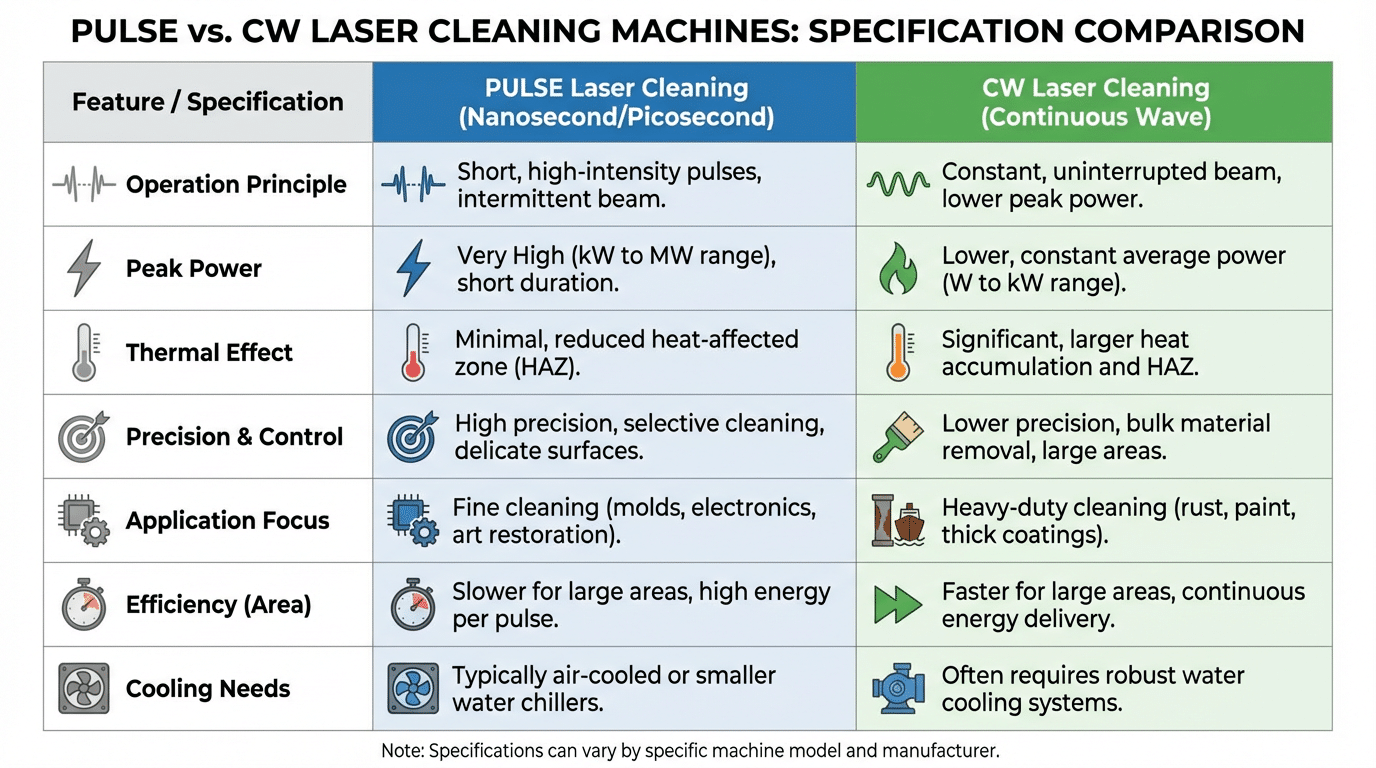
Choosing between pulse and continuous wave (CW) lasers is the first and most important decision you’ll make. They operate differently and are suited for different applications.

Pulse Laser Cleaning
Pulse lasers deliver energy in short, high-intensity bursts. They are ideal for high-precision cleaning on delicate substrates. Because the laser is only ‘on’ for a fraction of a second, heat accumulation is minimal, preventing damage to the base material.
- Best for: Precision mold cleaning, historical restoration, aerospace parts, and delicate surface treatment.
- Pros: High precision, no thermal damage, excellent for sensitive metals.
- Cons: Higher initial cost per watt compared to CW.
Continuous Wave (CW) Laser Cleaning
CW lasers provide a steady stream of energy. They are the “workhorses” of the industry, capable of removing thick layers of rust or paint from large, durable surfaces very quickly.
- Best for: Heavy rust removal on bridges, ship hulls, and large steel structures.
- Pros: Extremely fast, lower cost for high-power units.
- Cons: Risk of heat buildup on thin or sensitive materials.
Detailed Specifications Comparison
| Feature | Pulse Laser | CW Laser |
|---|---|---|
| Cleaning Precision | High (No substrate damage) | Moderate (Possible thermal effect) |
| Cleaning Speed | Moderate | High |
| Cooling System | Air/Water | Water |
| Portability | High (Lightweight options) | Moderate to Heavy |
| Primary Target | High-value, precision parts | Large-scale heavy industry |
Power Selection: From 100W to 2000W+
The power of your laser cleaning machine determines how quickly it can clean and what thickness of contaminants it can handle. In 2026, we categorize power levels into three main tiers:
Low Power (100W – 300W)
These units are typically portable and used for precision work. They are perfect for cleaning small parts, historical artifacts, or removing thin layers of oxides. If you are a restoration expert or a small workshop owner, a 100W-200W system is an excellent entry point.
Medium Power (500W – 1000W)
Medium power machines offer a balance between speed and precision. They are commonly used in automotive maintenance for engine block cleaning or localized rust removal. They are also suitable for pre-welding surface preparation.
High Power (1500W – 2000W+)
High-power systems, usually CW lasers, are designed for industrial-scale cleaning. They can remove millimeters of rust or paint per second. These are the go-to choices for shipyards, refineries, and heavy equipment manufacturers.
Power Comparison Table
| Power | Cleaning Speed (m²/h) | Best Application | Portability |
|---|---|---|---|
| 100W – 200W | 0.5 – 2 | Small molds, delicate artifacts | Handheld / Backpack |
| 500W – 1000W | 5 – 12 | Automotive parts, welding prep | Trolley / Portable |
| 1500W – 2000W | 15 – 40+ | Heavy rust, large steel beams | Large Industrial Unit |
Major Application Scenarios for Laser Cleaning
The versatility of the laser cleaning machine allows it to replace several traditional processes.
1. Rust Removal (De-rusting)
Oxidation is the enemy of any metal structure. Laser cleaning provides a deep, thorough de-rusting without the dust of sandblasting or the acids of chemical cleaning. It reaches into tiny pits that mechanical tools often miss.
2. Paint and Coating Removal
Whether you’re stripping a classic car or repainting a bridge, laser cleaning removes paint layers selectively. You can even remove just the top coat while leaving the primer intact.
3. Surface Treatment & Oil Removal
In manufacturing, surface tension is critical for bonding and coating. A laser cleaning machine removes oils and grease instantly, creating a pristine surface that exceeds aerospace standards for bonding.
ROI Analysis: Why Invest Now?
The upfront cost of a laser cleaning machine is often the biggest hurdle. However, the long-term ROI is significantly higher than traditional methods when considering labor, consumables, and waste management.
A Practical ROI Example
Let’s compare cleaning 10,000 m² of steel over a year:
- Sandblasting: Requires tons of abrasive media, extensive PPE, and massive waste disposal costs. Estimated cost: $15/m².
- Chemical Cleaning: High cost of chemicals, neutralization, and hazardous waste disposal. Estimated cost: $12/m².
- Laser Cleaning: Electricity and minimal maintenance. No consumables. Estimated cost: $1.50/m².
Even with an initial investment of $30,000 for a high-quality machine, the savings in consumables and labor usually result in a break-even point within 6 to 12 months for active workshops.
6 Key Factors to Check Before Buying
- Laser Source Brand: Look for reputable brands like IPG, Raycus, or JPT. The source is the heart of the machine.
- Cooling Efficiency: High-power lasers generate heat. Ensure the water cooling system is robust enough for your climate.
- Control Software: User-friendly interfaces with presets for different materials (rust, paint, aluminum) save hours of training.
- Fiber Cable Length: For large structures, you need a flexible and long fiber cable (standard is 5-10m, but 20m is available).
- Safety Certification: Ensure the machine is CE/FDA compliant with proper laser safety housing and goggles.
- After-Sales Support: Choose a supplier that offers technical support and reachable spare parts.
Conclusion: Selecting Your Future Tool
Investing in a laser cleaning machine in 2026 is no longer just about cleaning—it’s about operational efficiency and environmental responsibility. For precision work, the pulse laser remains king. For volume and scale, the CW laser is unbeatable.
Explore our range of solutions to find the perfect fit for your needs:
- Discover our Standard Industrial Laser Cleaners.
- Check out our Handheld Portable Laser Cleaning Units.
- Learn more about High-Power CW Solutions for heavy industry.
The future of surface preparation is light—fast, clean, and profitable.