
With the rapid development of modern manufacturing in terms of intelligence, automation and digitalization, laser processing technology, which is characterized by high precision, high efficiency and high flexibility, has been widely used in the field of engineering machinery manufacturing. This study explores the application and development potential of laser processing technology in engineering machinery manufacturing, analyzes its advantages in key processes such as cutting, welding, surface treatment and precision machining, and proposes its important role in improving product quality and production efficiency, providing a technical basis and practical guidance for technological innovation and industrial upgrading of the engineering machinery manufacturing industry.

Principles and characteristics of laser processing technology
1.1 Basic principles of laser processing technology
Laser processing technology is a method of processing materials using high-power density laser beams. The principle is to achieve the purpose of processing by interacting with lasers to achieve the melting, vaporization or heat-affected zone of materials. Laser processing technology has the characteristics of non-contact, high precision, high speed and strong flexibility. It can realize the processing of complex shapes and reduce the thermal impact and deformation of materials. In the field of engineering machinery manufacturing, the application of laser processing technology can significantly improve processing accuracy and efficiency and reduce production costs. It is one of the indispensable high-precision and cutting-edge technologies in modern manufacturing.
1.2 Main types of laser processing technology
Laser cutting, laser welding, laser marking, laser engraving, laser surface hardening, laser cladding, etc. are common types of applications in laser processing technology. Laser cutting technology occupies an important position in metal sheet processing with high cutting speed and excellent cutting quality. Laser welding is widely used in the field of precision welding with its advantages of deep melting, wide width, small heat-affected zone, and small deformation. Laser marking and engraving technology plays an important role in product identification and artistic creation with its high precision and non-wear characteristics. Laser surface hardening and cladding technology improves the wear resistance and corrosion resistance of the workpiece by changing the surface properties of the material. These technologies have their own characteristics and complement each other, promoting the widespread application and development of laser processing technology in engineering machinery manufacturing.
1.3 Advantages and limitations of laser processing technology
Laser processing technology occupies an important position in modern manufacturing industry with many advantages such as high processing precision, fast speed, small heat-affected zone, and automation and intelligent control. Laser processing can realize fine operation of materials, reduce material waste, and improve production efficiency. Its non-contact characteristics reduce mechanical stress on the workpiece and are suitable for processing brittle materials and high-precision requirements. This technology also has certain limitations, such as high equipment cost, specific requirements for the operating environment, limited processing efficiency of some materials, etc., and high energy consumption and thermal effect control problems may also occur during laser processing.
Application direction of laser processing technology in engineering machinery manufacturing
2.1 Application direction 1: cutting technology
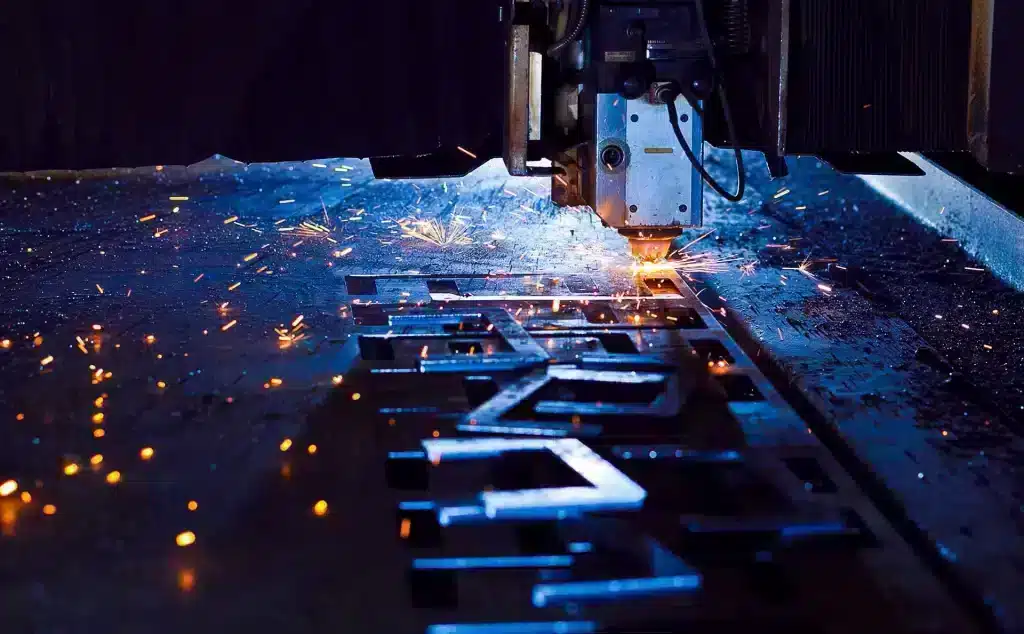
Laser cutting technology plays a vital role in engineering machinery manufacturing. This technology uses a high-energy-density laser beam to perform non-contact cutting of materials to achieve high-precision and high-speed processing effects. Compared with traditional mechanical cutting methods, it has incomparable advantages, including smaller heat-affected zone, less processing deformation, wider material adaptability, and more flexible processing path design. Laser cutting technology is widely used in the processing of thick plates and special-shaped parts. Engineering machinery usually requires structural parts to have high strength and rigidity. Laser cutting can accurately cut according to the design drawings, ensure the geometric dimensions and precision requirements of the parts, improve the performance and reliability of the whole machine, and can also achieve one-time molding of complex shapes, simplify the processing process, shorten the production cycle, and reduce manufacturing costs. However, laser cutting technology also faces some challenges in the application process. For high-reflectivity materials such as copper and aluminum, the efficiency and quality of laser cutting may be affected. The cost of laser cutting equipment and operation is relatively high, and the technical level of operators is also required to be high.
2.2 Application Direction 2: Welding Technology
As an advanced connection process, laser welding technology realizes the melting and solidification of materials through the high temperature generated by the focused laser beam to form a weld. It has the remarkable characteristics of deep melting and wide width, small heat-affected zone, fast welding speed, and small deformation, which makes laser welding play a key role in improving the connection strength and overall performance of engineering machinery structural parts. Laser welding technology is widely used in the connection of high-strength steel, aluminum alloy and other materials. The working environment of engineering machinery is complex and changeable, and it has extremely high requirements for the strength and durability of structural parts. Laser welding technology can provide high-quality welds, improve the mechanical properties of welded joints, and meet the reliability requirements of engineering machinery under harsh working conditions.
The high level of automation and intelligence of laser welding technology provides higher production efficiency and lower labor costs for engineering machinery manufacturing. By precisely controlling welding parameters, laser welding can achieve welding operations in complex shapes and inaccessible areas, solving problems that are difficult to overcome by traditional welding methods. Laser welding technology also has certain limitations in practical applications. It has strict requirements on the operating environment and material surface quality, and is highly sensitive to welding parameters, requiring precise control to avoid welding defects.
2.3 Application Direction 3: Surface Treatment Technology
Laser surface treatment technology is a key technology in the field of engineering machinery manufacturing. By irradiating the material surface with a laser beam, the surface properties of the material can be improved, including laser hardening, laser cladding and laser alloying, and the wear resistance, corrosion resistance and fatigue strength of the material surface can be significantly improved without changing the properties of the material matrix. In the field of engineering machinery, the working environment is often harsh, and there are extremely high requirements for the durability and reliability of components. The application of laser surface treatment technology can effectively extend the service life of mechanical components and reduce maintenance costs. Laser cladding technology can add a layer of material with specific properties to the surface of mechanical components, giving the components additional wear resistance, corrosion resistance or high temperature resistance.
The non-contact and high controllability of laser surface treatment technology have unique advantages when processing complex shapes or difficult-to-reach areas. Compared with traditional surface treatment technology, laser treatment reduces material waste, improves processing efficiency, and also reduces the impact on the environment. Laser surface treatment technology also faces some challenges in practical applications. The complexity of the technology itself requires operators to have high professional skills. The high cost of equipment and strict requirements on environmental conditions are also factors that restrict its widespread application. In order to overcome these challenges, researchers need to continuously explore more efficient processing processes, optimize parameter settings, and reduce costs through technological innovation.
2.4 Application Direction 4: Precision Micromachining Technology
In the precision machining process of important parts of engineering machinery, the wide adaptability to material types is a major advantage of the application of laser micromachining technology. For materials such as metals, ceramics or plastics, laser micromachining can provide efficient application solutions and provide stronger technical support for the realization of diversified design and functional integration of engineering machinery. However, it should be noted that the precise control of laser parameters in the micromachining process is very high, and even extremely small deviations may lead to a decrease in machining accuracy. In order to give full play to the potential of laser micromachining technology in the manufacturing of precision parts, researchers should continuously improve the process level of laser equipment, update and optimize the laser control system, reduce equipment costs through the integration of various disciplines, strengthen the training of equipment operators, and improve the understanding and application ability of laser micromachining technology.
Development Trends and Challenges of Laser Processing Technology in Engineering Machinery Manufacturing
With the rise of intelligent manufacturing and the demand for sustainable development, the application prospects of laser processing technology in the engineering machinery manufacturing industry are becoming more and more broad. Laser processing technology will pay more attention to the development direction of high efficiency, precision and intelligence. The research and development of high-power lasers will promote a significant improvement in cutting and welding speed and quality. The advancement of laser micromachining technology will also meet the demand for high-precision components. With the integration of computer-aided design and artificial intelligence algorithms, the laser processing process will achieve a higher level of automation and intelligence.
Laser processing technology also faces many challenges in its development. The high cost of equipment, high requirements for operating skills, and in-depth understanding of material properties are all factors that restrict its widespread application. The thermal impact, deformation control, and stability of processing accuracy during laser processing are also technical problems that need to be solved. Researchers need to strengthen basic research, optimize process parameters, develop new laser processing equipment, and cultivate professional talents to promote the widespread application and in-depth development of laser processing technology in engineering machinery manufacturing. Through continuous technological innovation and process improvement, laser processing technology is expected to play a more critical role in improving the performance of engineering machinery, reducing production costs, and promoting the green transformation of the manufacturing industry.