
What is Laser Welding?
Simply put, laser welding involves heating the surface of the workpiece with laser radiation. The surface heat then diffuses inward through heat conduction. By controlling the width, energy, peak power, and repetition frequency of the laser pulse, the workpiece melts, forming a specific molten pool, thereby achieving welding.Spot welding, a localized form of laser welding, focuses on joining small, closely spaced parts efficiently and with precision.
Key benefits include reducing the input heat to the minimum required amount, minimizing the heat-affected zone, and reducing deformation caused by heat conduction. Laser welding can also minimize wear and deformation of the machine due to its non-contact nature. Additionally, the laser beam can be easily focused, aligned, and guided by optical instruments and can be placed at a suitable distance from the workpiece.
Laser welding also allows welding of small and closely spaced parts, is compatible with a wide range of materials, and can even join various heterogeneous materials. It supports automation, high-speed welding, and is controllable digitally or via a computer. When welding thin materials or small-diameter wires, remelting issues are avoided.
Current Development Status of Laser Welding Technology
Laser welding technology has advanced alongside laser technology. In recent years, innovations such as blue laser, green laser, femtosecond laser, swing welding, and ARM (Adjustable Ring Mode) welding have emerged. These have addressed many welding issues in industrial production, rapidly promoting and developing laser welding across various sectors.
Metal Laser Welding Technology
The high energy density of lasers enables welding of difficult-to-weld materials. However, welding highly reflective metals such as gold, silver, copper, and aluminum still presents challenges. Some issues include:
- High reflectivity and thermal conductivity, requiring higher starting power for welding.
- Sensitivity to surface changes during high-power welding, leading to poor weld formation.
- Fast welding speeds causing defects such as internal pores, especially with aluminum and its alloys.

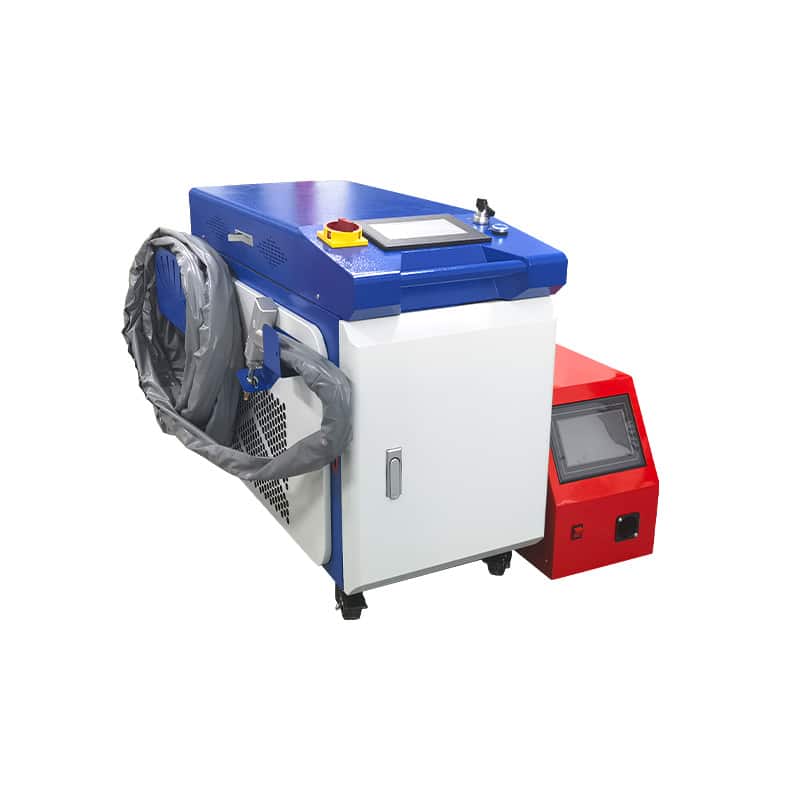
Efficient Laser Welding of Copper and Copper Alloys
Copper’s excellent electrical and thermal conductivity makes it widely used in electronics and electric vehicles, particularly in motors, batteries, sensors, wiring harnesses, and terminals.
Traditional infrared laser welding of copper was inefficient due to copper’s low absorption rate of infrared light. This resulted in spatter, splashing, and penetration depth issues. The development of high-power short-wavelength lasers, including green lasers, blue lasers, and dual-beam composite welding, has addressed these issues.
- Green Laser Welding: The green laser, with a wavelength of 500-560 nm, has an absorption rate of about 40% for copper, 8 times higher than infrared lasers. This reduces threshold power for deep melting welding and minimizes spatter, producing more uniform welds.
- Blue Laser Welding: Blue lasers (400-500 nm wavelength) improve absorption rates by up to 60% for copper and other reflective metals. They require less power, with energy consumption for copper welding being 84% lower than with infrared lasers.
- Dual-Beam Composite Welding: Combining infrared and visible light, this process achieves deep-melting copper welding with reduced power and spatter, offering high-quality, cost-effective welding.
Laser Swing Welding of Aluminum Alloys
Welding aluminum alloys with conventional laser beams often leads to defects like pores, mainly due to:
- Molten pool and keyhole instability causing collapse and pore formation.
- Hydrogen solubility changes during solidification leading to hydrogen pore formation, causing stress concentration and weld cracking.
Laser swing welding addresses these issues by increasing the beam action area, improving keyhole and molten pool stability, and reducing porosity through beam stirring, accelerating bubble escape from the molten pool.
Current Applications of Laser Welding Technology
Laser welding is used in numerous fields, including automobile manufacturing, electronics, aerospace, and medical equipment. Initially used in low-power applications like molds, advertising characters, glasses, jewelry, and shower doors,the development of high-power fiber and semiconductor lasers has opened up new possibilities for metal processing, automotive production, and power battery welding.
Development Trends in Laser Welding Technology
The future of laser welding technology looks promising. Key trends include:
- High-speed, efficient welding of metals with minimal deformation.
- Ability to weld a wide variety of metals, including heterogeneous materials, overcoming traditional material compatibility issues.
- Greater adoption in aerospace, automotive, electronics, and medical fields.
Laser welding’s ability to provide fast, precise, and non-invasive welding continues to revolutionize modern industrial production.