
Handheld Laser Welder vs MIG Welder: A Practical Comparison
In the modern metal fabrication landscape, choosing the right equipment can make the difference between a profitable operation and a bottlenecked workshop. One of the most debated topics today is the handheld laser welder vs MIG welder. While Metal Inert Gas (MIG) welding has been the industry standard for decades, fiber laser technology is rapidly disrupting the market. This article provides a comprehensive comparison to help you decide which technology fits your production needs in 2026.
The Evolution of Welding Technology
Welding has always been a balance of heat control, speed, and structural integrity. For years, MIG welding offered a reliable, relatively fast way to join metals. However, as demands for precision and aesthetics increased—especially in stainless steel and aluminum fabrication—the limitations of MIG became apparent. Enter the handheld fiber laser welder: a tool that promises the speed of a machine with the flexibility of a hand tool.
What is MIG Welding?
MIG welding, or Gas Metal Arc Welding (GMAW), uses a continuous solid wire electrode fed through a welding gun. An electric arc forms between the wire and the workpiece, melting both to create a join. A shielding gas (like Argon or CO2) protects the weld from atmospheric contamination.
Pros of MIG:
- Low initial investment.
- Excellent for thick materials (>10mm).
- Huge ecosystem of parts and trained operators.
Cons of MIG:
- High heat input leads to material distortion.
- Significant “spatter” requires post-weld grinding.
- Steeper learning curve for high-quality aesthetic welds.
What is Handheld Laser Welding?
Handheld laser welding uses a concentrated beam of fiber laser light to fuse metals. It is a high-energy density process that creates a “keyhole” weld, allowing for deep penetration with minimal heat spread.
Pros of Laser:
- Up to 4-10x faster than traditional methods.
- Minimal heat-affected zone (HAZ), meaning almost zero distortion.
- Aesthetic, “surgical” precision welds with no spatter.
- Extremely easy to learn for beginners.
Cons of Laser:
- Higher upfront equipment cost.
- Strict safety requirements (enclosures/PPE).
- Less effective on very thick structural steel (typically capped at 8-10mm for handheld).
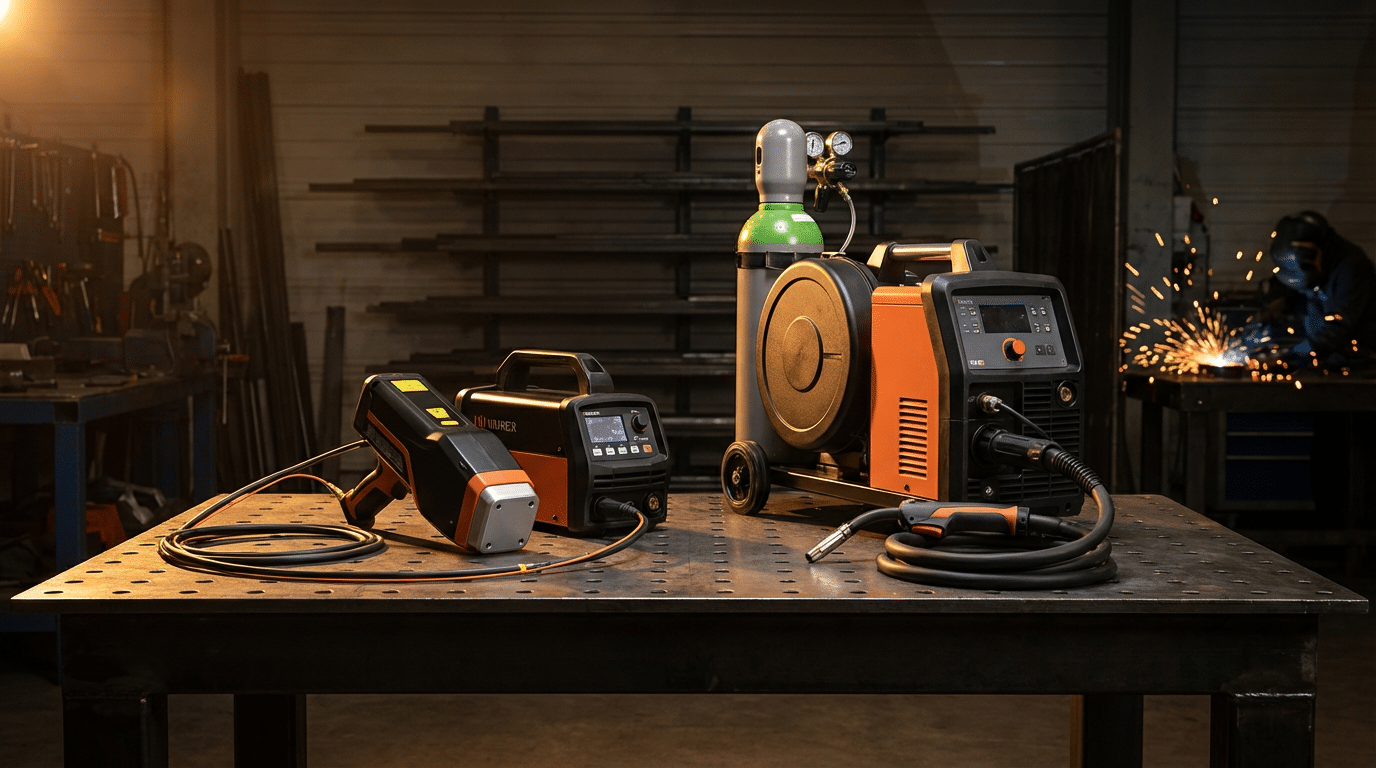
Handheld Laser Welder vs MIG: A Deep Dive into Performance
When we look at handheld laser welder vs MIG performance, several factors stand out that directly impact a shop’s bottom line.
1. Speed and Efficiency
Laser welding is unequivocally faster on thin to medium materials (0.5mm to 6mm). In typical shop tests, a laser welder can complete a seam at 2-3 meters per minute, whereas a MIG welder might struggle to reach 0.5 meters per minute without risking burn-through or excessive heat.
2. Weld Quality and Aesthetics
One of the biggest advantages of laser welding is the lack of spatter. In MIG welding, tiny molten droplets (spatter) fly off the arc and stick to the surrounding metal. Removing this spatter requires hours of labor with a grinder. Laser welding produces a “clean” beam, resulting in a weld that often looks like it was done by a robot.
3. Learning Curve
Finding skilled MIG welders is increasingly difficult. Laser welding, however, is remarkably intuitive. Most operators can produce high-quality welds after just a few hours of training. The “wobble” function on modern laser guns compensates for slightly uneven gaps, making the process much more forgiving for novices.
4. Material Versatility
While MIG handles carbon steel well, it struggles with highly reflective or thin materials like aluminum and brass. Laser welders excel here. The high energy of the fiber laser easily overcomes the reflectivity of aluminum, producing strong, clean joints that are notoriously difficult to achieve with MIG.
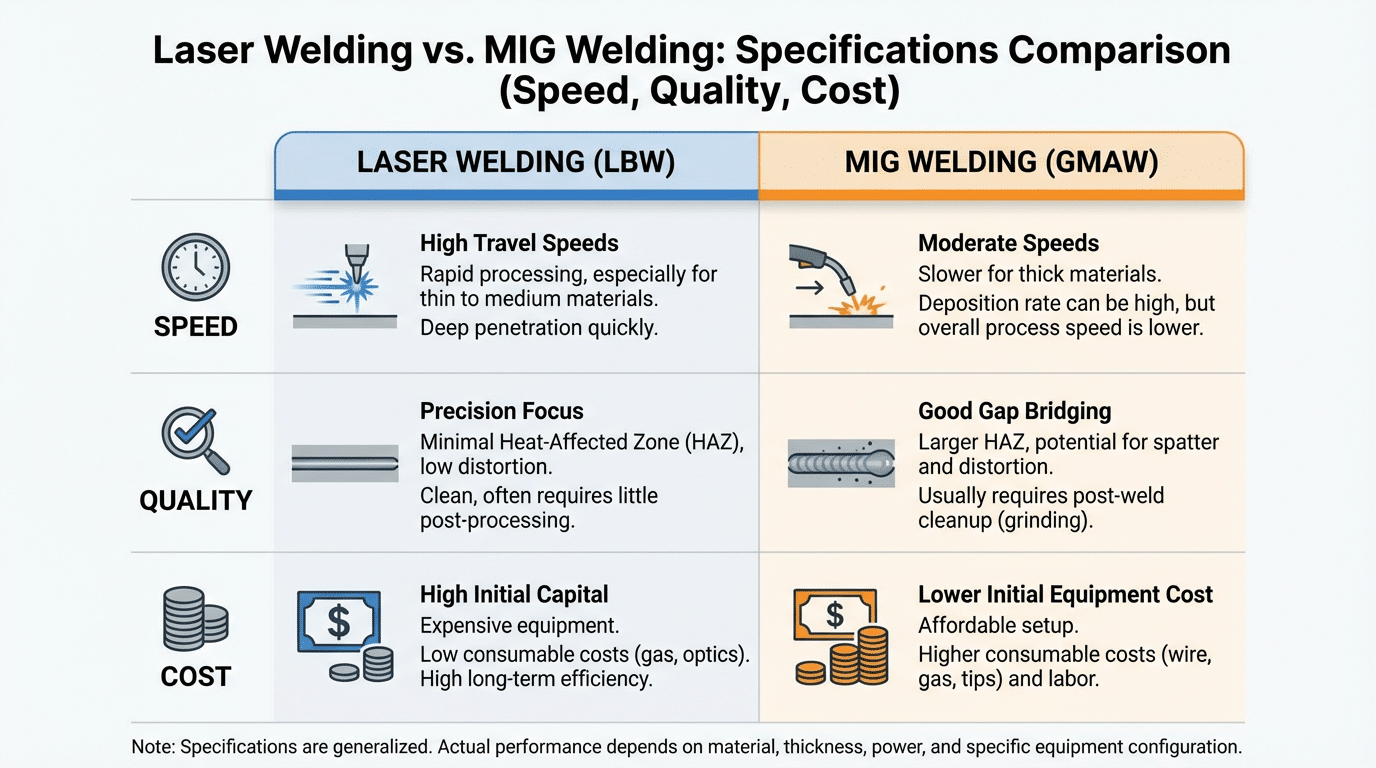
Comprehensive Comparison Table
| Feature | Handheld Laser Welder | MIG Welder |
|---|---|---|
| Welding Speed | Ultra-Fast (4x-10x) | Moderate |
| Heat Input | Very Low | High |
| Distortion | Minimal/None | Significant on thin sheets |
| Post-Weld Processing | None to Minimal | Heavy Grinding/Polishing |
| Ease of Use | High (Hours to learn) | Moderate (Months to master) |
| Initial Cost | High ($8k – $20k) | Low ($1k – $5k) |
| Maintenance | Low (Optical parts) | Moderate (Liners, Tips, Wire) |
| Safety | High (Class 4 Laser) | Standard (Arc/Fumes) |
ROI Analysis: Long-term Cost Comparison
Fabricators often focus on the $15,000 price tag of a laser welder compared to a $3,000 MIG machine. However, the ROI of laser welding usually occurs within 6-12 months due to:
- Labor Savings: If one laser welder does the work of three MIG welders, the labor cost reduction is massive.
- Consumable Savings: No need for expensive grinding discs, polishing compounds, or rework.
- Energy Efficiency: Fiber lasers are significantly more energy-efficient than traditional arc welders.
For those looking to upgrade their production line, checking out the latest Handheld Laser Welding Systems is a vital first step in calculating these savings.
Advantages of Laser Welding: The Precision Powerhouse
- No Splatter: Keeps the workspace and the workpiece clean.
- Less Distortion: Essential for aesthetic panels and precision cabinets.
- No Grinding: Saves 30-50% of the total fabrication time.
- Operation Simplicity: Move your best MIG welders to thick structural tasks and let junior staff handle the laser welding of thin components.
If you are looking for specific hardware, explore the Laser Cleaning and Welding combo units that offer even more versatility for surface preparation.
Advantages of MIG Welding: The Structural Workhorse
Despite the rise of lasers, MIG remains essential for:
- Thick Plates: For structural steel over 12mm, MIG’s high deposition rate is superior.
- Initial Cost: For small hobbyist shops, the entry price of MIG is unbeatable.
- Field Use: Laser welders require precise environments and stable power, whereas MIG machines are more rugged for outdoor construction.
Which One Should You Choose?
Choose Handheld Laser Welding if:
- You work primarily with stainless steel, aluminum, or thin carbon steel (0.5mm – 6mm).
- Your products require high aesthetic standards (furniture, signage, medical equipment).
- You want to reduce labor costs and eliminate grinding.
- You struggle to find experienced welders.
Consider the high-performance laser sources available at Laser Scheme to ensure your system has the reliability required for industrial shifts.
Choose MIG Welding if:
- You are a structural steel fabricator working on heavy beams and plates.
- Your budget is extremely tight for a new machine.
- You primarily do outdoor or onsite repairs.
Scenario Analysis: Material-Specific Performance
When choosing between a handheld laser welder vs MIG, the material type is often the deciding factor.
Stainless Steel: The Laser’s Home Turf
In the world of stainless steel fabrication—common in food service, medical, and high-end furniture—aesthetics are paramount. MIG welding on stainless often results in “discoloration” or heat-tinting that requires chemical cleaning or heavy polishing. Handheld laser welding provides such localized heat that the material retains its corrosion-resistant properties without the need for aggressive post-weld cleaning. The speed advantage on 1-3mm stainless is nearly 8x that of MIG.
Aluminum: Overcoming the Reflectivity Barrier
Aluminum is notoriously difficult for MIG welding because it conducts heat so well and has a reflective surface that can cause arc instability. Laser welding, particularly with fiber sources, provides enough power density to “break” the surface tension of aluminum instantly. This results in deep penetration and a weld bead that is significantly stronger and more visually appealing than a standard aluminum MIG bead, which often looks “stacked” and bulky.
Carbon Steel: Efficiency vs. Depth
For carbon steel, MIG is a very capable tool. However, for thin-gauge cabinetry (under 2mm), laser welding eliminates the “warping” that often forces fabricators to spend hours straightening panels. If your shop handles thin-gauge mild steel for enclosures or HVAC ducting, the handheld laser will revolutionize your throughput.
ROI Analysis: The Numbers Behind the Switch
Let’s look at a hypothetical 12-month ROI for a medium-sized workshop switching one station from MIG to Laser.
Assumptions:
- Material: 2mm Stainless Steel.
- Weld Length: 100 meters per week.
- Labor Rate: $40/hour (including benefits).
MIG Scenario:
- Welding Speed: 0.4 m/min -> 250 minutes (4.2 hours) per week.
- Grinding/Polishing: 3 hours for every 1 hour of welding -> 12.6 hours per week.
- Consumables (Wire, Gas, Discs): $150 per week.
- Total Weekly Cost: $672 (Labor) + $150 (Consumables) = $822.
- Annual Cost: ~$42,744.
Laser Scenario:
- Welding Speed: 2.0 m/min -> 50 minutes (0.83 hours) per week.
- Grinding/Polishing: 0.5 hours for every 1 hour of welding -> 0.4 hours per week.
- Consumables (Nozzles, Protective Lens, Gas): $60 per week.
- Total Weekly Cost: $49 (Labor) + $60 (Consumables) = $109.
- Annual Cost: ~$5,668.
Total Annual Savings: Over $37,000.
Even with a $15,000 initial investment for a high-quality fiber laser source, the machine pays for itself in less than five months. This doesn’t even account for the increased capacity to take on more jobs or the reduction in material scrap from heat distortion.
Safety and Maintenance: What to Expect
Operating a handheld laser requires a different safety mindset than MIG.
Laser Safety:
- Class 4 Laser: The beam is invisible and can cause permanent eye damage or skin burns instantly.
- Enclosures: A dedicated “Laser Room” or partitioned area with interlocked doors is standard practice.
- PPE: Specialized laser goggles (OD7+ rating) are mandatory for everyone in the vicinity.
MIG Safety:
- Arc Flash: UV radiation requires welding helmets.
- Fumes: Significant smoke and fumes require active extraction systems.
- Spatter/Burns: Heavy leather gear is needed to protect from molten metal.
In terms of maintenance, a MIG machine has many moving parts—wire feeders, liners, and contact tips that wear out daily. A laser welder’s primary maintenance involves cleaning the protective lens and ensuring the water-cooling system is topped up. While the components of a laser system are more expensive individually, they are changed far less frequently.
The Future of Fabricating: A Hybrid Approach
Many successful shops are not replacing MIG entirely but rather adopting a hybrid approach. They use integrated laser systems for all thin-to-medium decorative work and precision components, while keeping a few high-powered MIG/TIG stations for structural frames and heavy-duty repairs.
This balance allows for the highest possible production efficiency while maintaining the capability to handle any project that comes through the door.
Conclusion
The handheld laser welder vs MIG debate isn’t about which technology is “better” in a vacuum, but which is right for your specific application. For most light-to-medium fabrication shops, the speed, quality, and ease of use of a fiber laser welder offer a competitive advantage that traditional MIG simply cannot match. While MIG will always have its place in heavy industry, the “Laser Revolution” is here to stay for precision metalwork.
Explore our full range of industrial laser solutions to find the perfect fit for your workshop today.