
In the rapidly evolving world of industrial fabrication, the handheld laser welder has emerged as a revolutionary tool that is fundamentally changing how we approach metal joining. As we move through 2026, the technology has reached a point of maturity where it is no longer just a luxury for high-end shops but a critical investment for any business looking to increase productivity, reduce labor costs, and achieve superior weld quality. This complete buyer’s guide will walk you through everything you need to know about choosing the right handheld laser welder for your specific needs.
What Is a Handheld Laser Welder?
At its core, a handheld laser welder is a high-precision welding tool that uses a concentrated fiber laser beam to melt and join metal surfaces. Unlike traditional welding methods that rely on an electric arc or a gas flame, the laser welder uses light energy to create a deep, narrow weld pool with a minimal heat-affected zone (HAZ).
The system typically consists of a fiber laser source (ranging from 1000W to 3000W), a cooling system (chiller), a control system, and the handheld welding torch. The welder holds the torch and moves it along the seam, much like a MIG or TIG torch, but with significantly more control and ease. The laser beam can be manipulated in various “wobble” patterns (circle, line, triangle, etc.) to compensate for gaps between workpieces, making it incredibly versatile for real-world manufacturing conditions.
For those looking for even more versatility, many modern systems are designed as 3-in-1 laser welding cleaning cutting machines, allowing operators to switch between welding, cleaning, and light cutting tasks with a simple nozzle change and setting adjustment.
Key Specifications to Consider
When evaluating a handheld laser welder, several technical specifications will determine its performance and suitability for your projects:
- Laser Power (1000W–3000W): This is the most critical spec. It determines the maximum penetration depth and welding speed. A 1000W machine is excellent for thin sheets (up to 3mm), while a 3000W machine can handle thick plates (up to 8mm or more) with ease.
- Fiber Type: Continuous Wave (CW) fiber lasers are the standard for welding. They provide a steady stream of energy for consistent, deep welds.
- Wire Feed System: Most handheld laser welders now come with an automatic wire feeder. This is essential for filling gaps and creating stronger structural welds. Look for a system that supports various wire diameters (0.8mm to 1.6mm).
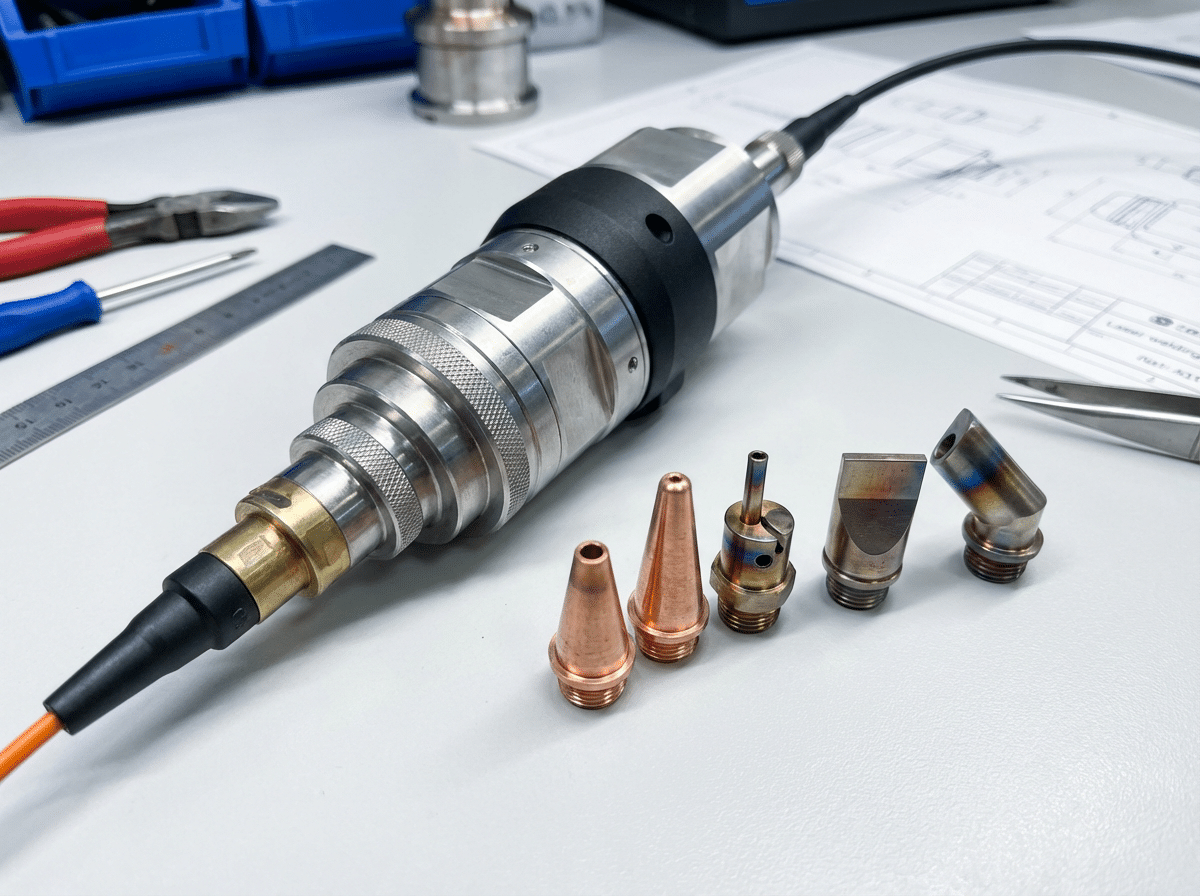
- Nozzle Types: Different welding tasks require different nozzles (e.g., for fillet welds, butt welds, or wire feeding). A good kit should include a variety of copper nozzles.
- Wobble Width: The ability to “wobble” the laser beam (usually up to 5mm or 6mm) is crucial for handling imperfect fit-ups and creating wider weld beads.
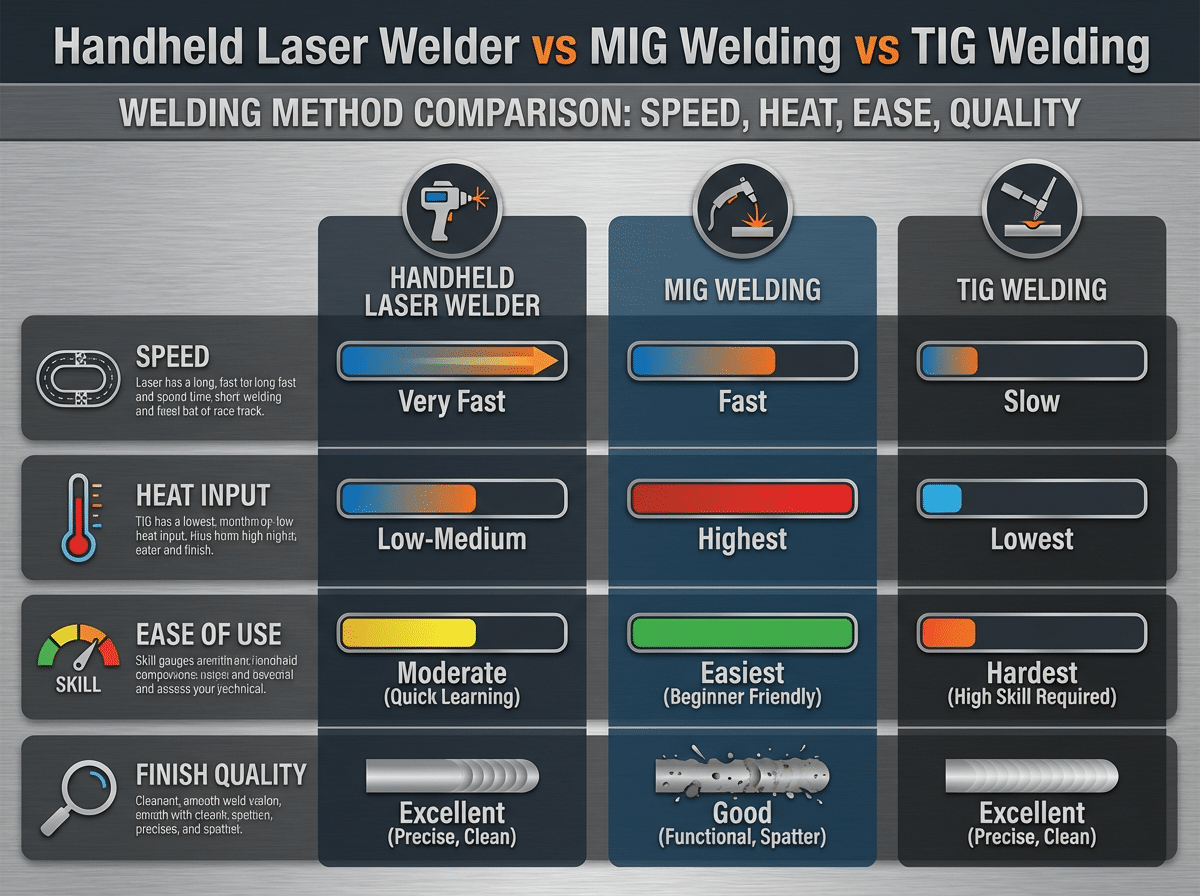
Handheld Laser Welder vs MIG/TIG Welder: Side-by-Side Comparison
To understand why so many shops are switching to laser technology, it’s helpful to look at how it compares to traditional MIG and TIG welding.
| Feature | Handheld Laser Welder | TIG Welder | MIG Welder |
|---|---|---|---|
| Welding Speed | Very Fast (up to 10x faster) | Slow | Moderate |
| Learning Curve | Low (hours/days) | High (months/years) | Moderate |
| Heat-Affected Zone | Minimal (low distortion) | Moderate | High |
| Post-Weld Processing | Minimal (often none) | Some grinding needed | Heavy grinding needed |
| Precision | Extreme | Very High | Moderate |
| Safety Requirements | Laser Safety Gear Needed | Welding Mask/PPE | Welding Mask/PPE |
Top Applications for Handheld Laser Welding
The versatility of the handheld fiber laser welder makes it suitable for a wide range of industries:
- Stainless Steel Fabrication: Perfect for kitchen equipment, medical devices, and decorative elements where a clean, oxidation-free finish is required.
- Aluminum Welding: Traditionally difficult to weld with MIG/TIG due to heat conductivity, aluminum is easily handled by the concentrated energy of a laser.
- Kitchen and Bathroom Products: Creating seamless joints in sinks, cabinets, and appliances without the need for intensive polishing.
- Doors and Windows: Fast, efficient welding of frames and handles with minimal thermal distortion.
- Automotive Parts: Precise welding of thin-walled components and brackets.
In cases where parts need cleaning before or after welding, some shops utilize a pulse laser cleaning machine to ensure the highest possible bond strength and surface finish.
How to Choose the Right Power Level
Choosing the correct wattage is vital for balancing performance and cost. Here is a general guide for 2026:
- 1000W: Ideal for thin materials up to 2.5mm or 3mm. Excellent for precision work and small shops specializing in light-gauge stainless steel.
- 1500W: The “sweet spot” for many fabricators. It handles up to 4mm stainless and carbon steel with excellent speed and reliability.
- 2000W: Necessary for shops working with thicker materials (up to 5mm or 6mm) or those needing high-speed production on medium-thickness sheets.
- 3000W: The heavy-duty option. It can penetrate 8mm+ materials and offers the fastest possible welding speeds for thinner materials.
Handheld Laser Welder Price Guide 2026
While prices have stabilized as the technology has become more common, there is still a range based on quality, power, and the brand of the laser source (e.g., Raycus, MaxPhotonics, or IPG). On average, you can expect the following price ranges:
- 1000W – 1500W: $4,500 – $7,500 USD
- 2000W: $7,000 – $10,000 USD
- 3000W: $11,000 – $15,000 USD
Remember that the cheapest option is rarely the best in the long run. High-quality components like dual-temperature chillers and reliable control systems are worth the extra investment to prevent downtime.
What to Look for in a Supplier
Buying a laser welder is a significant investment. When choosing a supplier, ensure they meet these criteria:
- CE Certification: Essential for safety and compliance in most markets.
- Technical Support: Do they offer 24/7 online support or local service? A laser machine is a complex tool; you need someone to call if you have questions.
- Warranty: Look for at least a 2-year warranty on the laser source.
- Shipping Options: For international buyers, DDP (Delivered Duty Paid) shipping can simplify the import process significantly.
- Training Resources: Video tutorials, manuals, and remote training sessions help your team get up to speed quickly.
Conclusion & Next Steps
The handheld laser welder is no longer the future of welding; it is the present. By offering unparalleled speed, ease of use, and quality, it provides a competitive edge that is hard to ignore. Whether you are a small custom shop or a large-scale manufacturer, there is a laser welding solution that fits your production needs.
Ready to upgrade your fabrication capabilities? Explore our full range of handheld fiber laser welders and see how we can help you streamline your workflow today. Contact us for a personalized quote and technical consultation!