
In the rapidly evolving landscape of modern manufacturing, the handheld laser welder has emerged as a transformative technology, redefining the boundaries of precision, speed, and versatility. As we move into 2026, the demand for high-quality, efficient welding solutions has never been greater, and handheld fiber laser welding systems are leading the charge by offering a user-friendly alternative to traditional methods. This guide covers everything you need to know about choosing the right handheld laser welder for your business, from technical specifications to practical applications.
Whether you are a small workshop owner looking to increase throughput or a large-scale industrial manufacturer seeking to reduce labor costs, understanding the nuances of laser welding technology is essential. A handheld laser welder allows operators to achieve consistent, aesthetic welds on a variety of materials with minimal training compared to MIG or TIG welding. In the following sections, we will delve deep into the mechanics, comparisons, and purchasing factors that will help you make an informed decision in the 2026 market. We will explore how the transition from traditional arc-based systems to light-based fusion is creating a competitive edge for early adopters across the globe. The global supply chain shifts have made it imperative for companies to find ways to produce more with fewer specialized workers, and this is where laser technology truly shines.
What Is a Handheld Laser Welder?
A handheld laser welder is a portable welding device that utilizes a high-intensity fiber laser beam as its primary energy source to join metal components. Unlike traditional arc welding, which uses an electric arc to melt the base metal and filler rod, laser welding focuses a concentrated beam of light onto the workpiece. This results in a localized heat source that creates a deep, narrow weld pool with a high aspect ratio. The precision of this light beam allows for a level of control that was previously only available in large, automated robotic cells. This technology leverages the power of fiber optics to deliver consistent results over long periods, making it a reliable choice for high-volume environments.
The system typically consists of three primary components: the fiber laser source, the handheld welding gun, and the control system. The fiber laser source (often from brands like Raycus, MAX, or IPG) generates the laser light, which is then transmitted through a flexible fiber optic cable to the handheld welding gun. The gun is equipped with a collimating lens and a focusing lens to concentrate the beam. To protect the weld pool from oxidation, a shielding gas (usually Argon or Nitrogen) is delivered through a nozzle at the tip of the gun. The interplay between the laser beam, the shielding gas, and the optional wire feed system is what defines the quality of the final joint. Modern systems also incorporate advanced sensors that monitor the temperature and power stability in real-time, providing feedback to the operator. The fiber cable itself is a marvel of engineering, capable of maintaining beam quality even when coiled or moved extensively across a shop floor.
Key components include:
- Laser Source: The heart of the machine, determining the power output and beam quality. Modern sources are designed to be maintenance-free for up to 100,000 hours of operation. These sources utilize rare-earth doped fibers to amplify light with incredible efficiency.
- Chiller: An integrated cooling system that maintains the optimal temperature for the laser source and the welding gun. Without a high-efficiency chiller, the laser source would overheat during continuous industrial use. In 2026, dual-circuit chillers are the standard, cooling the laser and the gun optics separately.
- Wire Feeder: An automated system that supplies filler wire when larger gaps need to be filled. The wire feeder is synchronized with the laser pulse to ensure a smooth, consistent bead. It can handle various materials including stainless steel, aluminum, and carbon steel wires.
- Control Panel: A touch-screen interface where operators set parameters like laser power, frequency, and wobble width. Advanced systems in 2026 now include AI-assisted parameter suggestions based on material type and thickness. This reduces the setup time for new jobs from minutes to seconds.
Compared to traditional methods, the handheld laser welder offers a much smaller Heat Affected Zone (HAZ), which significantly reduces the risk of workpiece distortion and discoloration. This makes it ideal for thin materials and precision assemblies. In a traditional MIG setup, the heat often warps thin sheet metal, requiring extensive post-processing. With laser welding, the energy is so focused that the surrounding material remains relatively cool, preserving the structural integrity and aesthetic finish of the part. This low heat input is also beneficial for heat-sensitive electronic components or pre-coated metals where thermal damage must be avoided. Furthermore, the absence of electrode contact means no contamination of the weld pool, leading to metallurgical properties that often exceed those of the base metal itself.
Key Specifications to Evaluate
When shopping for a handheld laser welder in 2026, it is crucial to understand the technical parameters that dictate the machine’s performance. The specifications listed below are not just numbers on a datasheet; they represent the operational limits and capabilities of your investment. A deep understanding of these specs will allow you to match the machine to your specific production requirements. We also recommend looking at the duty cycle ratings, which indicate how long the machine can operate at maximum power without needing a rest period. The beam quality factor (M²) is another metric that industrial buyers are increasingly looking at to ensure deep penetration at lower power levels.
| Specification | Typical Range | Notes |
|---|---|---|
| Laser Power | 1000W / 1500W / 2000W / 3000W | Higher power allows for deeper penetration and faster speeds on thicker metals. 1500W is the current industry standard for general fabrication. |
| Fiber Cable Length | 10m – 15m | Provides flexibility for moving around large workpieces without moving the machine. Longer cables allow for use on large-scale structures like tanks or trailers. |
| Welding Wire Feed | 0.8mm – 2.0mm | Automated wire feeding is essential for filling gaps and structural strength. 1.2mm is most common for general purpose welding. |
| Nozzle Types | Copper Alloy (Multiple Shapes) | Different shapes (flat, corner, inner/outer) are used for various joint geometries. Quick-change nozzles increase efficiency during setup. |
| Cooling System | Integrated Water Chiller | Ensures stable operation during long shifts; high-capacity chillers are needed for 2kW+ units to maintain laser stability. |
| Display Type | LCD Touch Screen | Should support multiple languages and provide easy adjustment of wobble patterns. Intuitive UI reduces the learning curve for new operators. |
Understanding these specs ensures you don’t overspend on power you don’t need, or conversely, buy a machine that struggles with your primary materials. For instance, while a 1000W unit is excellent for light sheet metal, industrial fabrication of 5mm+ stainless steel often requires at least a 2000W handheld fiber laser welder. Additionally, the quality of the fiber optic cable itself is a factor; high-grade cables minimize power loss and provide the flexibility needed for intricate manual work. In 2026, we are also seeing the emergence of “smart” specifications, such as real-time power monitoring and safety interlocking systems that prevent the laser from firing unless the nozzle is in contact with a grounded workpiece. These safety circuits are mandatory for CE and OSHA compliance in most jurisdictions.
Another specification to keep an eye on is the power consumption in “standby” vs “active” modes. Modern laser sources are incredibly energy-efficient, often exceeding 30% wall-plug efficiency, which is significantly higher than older CO2 laser systems or traditional arc welders. This translates to lower operating costs and a smaller carbon footprint for your facility. The wobble frequency, measured in Hertz (Hz), is another key spec; higher frequencies allow for smoother finishes on delicate materials, while lower frequencies can help with deep penetration on structural steel joints.
Handheld Laser Welder vs MIG vs TIG: Side-by-Side Comparison
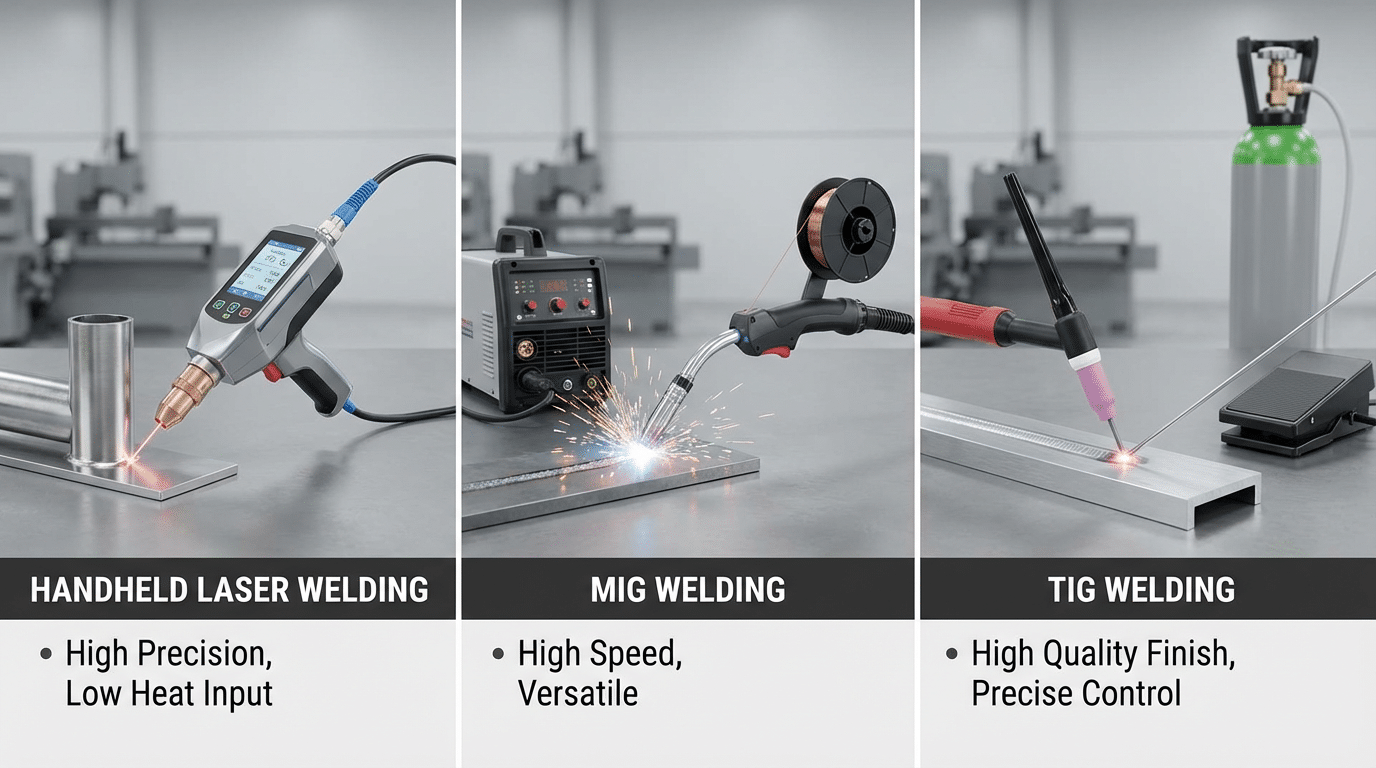
To truly appreciate the value of a handheld laser welder, one must compare it against the stalwarts of the industry: MIG (Metal Inert Gas) and TIG (Tungsten Inert Gas) welding. Each has its place, but the laser system offers distinct advantages in specific areas, particularly where speed and aesthetics are the primary goals. As labor markets tighten, the ability to produce high-quality welds with less skilled labor is becoming a major driver for adoption across North America and Europe. In many cases, the ROI for a laser system is measured not just in speed, but in the reduction of rejected parts and the elimination of secondary finishing processes.
| Feature | Handheld Laser | MIG | TIG |
|---|---|---|---|
| Weld Speed | Very Fast (Up to 10x TIG) | Moderate | Slow |
| Heat Input | Very Low | High | High |
| Distortion | Minimal | Significant on thin sheets | Moderate |
| Skill Required | Low (Learn in 30 mins) | Moderate | High (Years of experience) |
| Cost | High Initial / Low Labor | Low Initial / High Labor | Moderate Initial / Very High Labor |
| Best For | High-speed production, thin metal | Structural steel, heavy duty | High-precision, aesthetic welds |
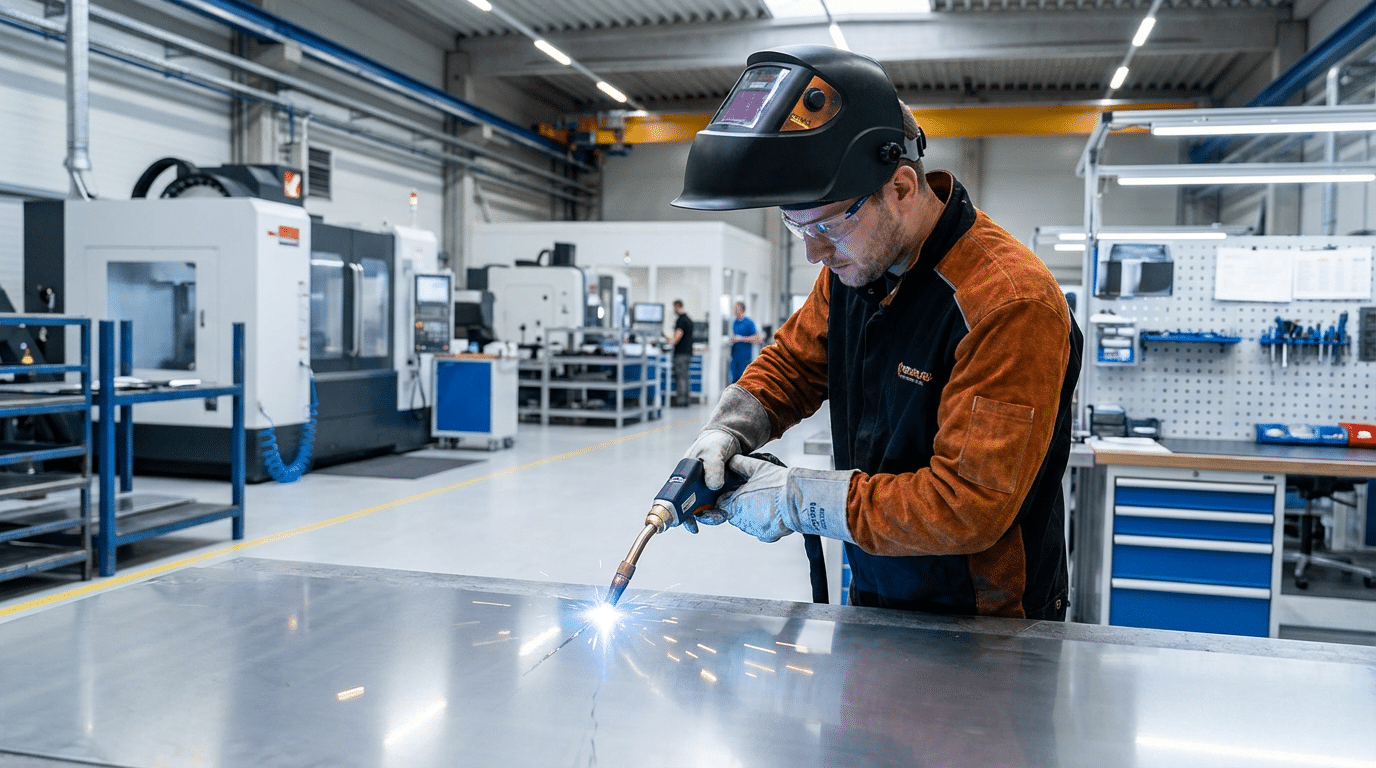
The primary draw of the laser system is the “skill gap.” In many regions, finding certified TIG welders is difficult and expensive. A handheld laser welder allows a general laborer to produce high-quality, aesthetic welds after just a few hours of training. This dramatically lowers the cost per weld in production environments. While TIG produces beautiful results on thin stainless steel, it requires a steady hand and complex foot pedal coordination. The laser welder, by contrast, uses a “wobble” function that oscillates the beam, making it much more forgiving of slightly inconsistent hand movements. This oscillation also helps in widening the weld pool to accommodate larger gaps, which is often a challenge in manual assembly where part fit-up might not be perfect.
Furthermore, post-weld cleanup is a hidden cost in traditional welding. MIG often leaves behind significant spatter that must be ground off, and TIG can cause “blueing” or heavy oxidation of the surrounding metal. The concentrated energy of the laser means the weld area is extremely clean, often requiring zero grinding or chemical cleaning. When you factor in the saved labor hours from post-processing, the higher initial investment of a laser system often yields a faster return than cheaper traditional alternatives. It’s not uncommon for shops to see a full return on investment in under six months when replacing two or more TIG stations with a single handheld laser unit. The ergonomic design of the laser gun also reduces fatigue, allowing operators to maintain high productivity throughout an entire shift without the wrist strain associated with heavy MIG torches.
Top Applications
The versatility of the handheld laser welder makes it suitable for a wide range of industries. From delicate kitchenware to heavy-duty automotive frames, the precision of fiber laser technology is being leveraged everywhere. In 2026, we are seeing specialized applications emerge that were previously thought impossible for manual welding systems. The ability to work on dissimilar metals and the lack of consumables (other than gas and protective lenses) makes it a favorite for forward-thinking shops looking to minimize their overhead.
- Stainless Steel Fabrication: Used extensively in the production of kitchen sinks, cabinets, and industrial shelving. The minimal discoloration saves hours of post-weld polishing. In high-end commercial kitchen builds, the ability to create seamless, “hidden” welds is a major selling point. The corrosion resistance of the weld area is also superior due to the lower heat input.
- Aluminum Kitchenware: Aluminum is notoriously difficult to weld with TIG due to its high thermal conductivity, but the high power density of a laser handles it with ease, producing clean, leak-proof joints. Many manufacturers of aluminum pots and pans have switched exclusively to laser welding for handle attachments and pressure cooker seals.
- Door & Window Frames: Precise corner welds on galvanized steel or aluminum extrusions are a staple application for these machines. The low heat input ensures that the thin walls of the extrusions do not buckle or melt away, maintaining the structural integrity of the frame. This is particularly important for high-performance thermal-break windows.
- Pressure Vessels: Small to medium-sized tanks and containers benefit from the deep penetration and airtight seals provided by the 3-in-1 laser welding cleaning cutting machine. The ability to switch from cleaning (to remove rust) to welding in one device is a game-changer for maintenance crews working in tight spaces.
- Automotive Bodywork: Ideal for repair work and the assembly of light components where structural integrity and appearance are both paramount. Electric vehicle (EV) manufacturers are increasingly using laser welding for battery enclosures and busbar connections where thermal management is critical to battery life.
- Advertising & Signage: Creating large channel letters out of thin stainless steel or aluminum. The laser provides the precision needed for sharp corners and intricate fonts that MIG simply cannot achieve. This has revolutionized the large-format sign industry by allowing for lighter, more durable structures.
Furthermore, many shops are now integrating these machines into their workflows alongside a pulse laser cleaning machine to ensure surfaces are perfectly prepared before welding and cleaned of any remaining oxidation afterward. Pre-cleaning is particularly important for aluminum and copper, where surface oxides can compromise the integrity of the laser-fused joint. This holistic approach to metal preparation and joining is the standard for high-quality manufacturing in 2026. The ability to weld thin-to-thick materials is another key application; for example, welding a 0.5mm sheet to a 5mm bracket is easily achievable with the laser’s precise energy control.
How to Choose the Right Power Level
Selecting the correct power level is the most critical decision in the buying process. Power directly correlates with the thickness of the material you can weld and the speed at which you can operate. Choosing too little power will result in poor penetration and weak joints, while too much power for thin materials can be a waste of electrical efficiency and capital investment. You should also consider the duty cycle of the machine, as higher power units often have more robust cooling systems that allow for longer continuous operation. In 2026, the power level is often matched with specialized software presets that optimize the beam profile for different penetration depths.
1000W: The Light Sheet Specialist
A 1000W handheld laser welder is perfectly suited for sheet metal workshops working primarily with materials between 0.5mm and 2mm. It offers the lowest entry price and consumes the least energy, making it an efficient choice for decorative metalwork and light assemblies. It is also the most portable option, often featuring a smaller form factor that fits into tight workshop spaces. If you are doing fine work on jewelry or electronic enclosures, the 1000W unit provides the finesse needed. It is also ideal for tack welding large assemblies before they move to a robotic station.
1500W: The Versatile All-Rounder
This is the most popular power level. It can comfortably handle up to 3mm-4mm stainless steel and 2mm-3mm aluminum. For most general fabrication shops, 1500W provides the perfect balance between price and performance. It has enough “overhead” to handle the occasional thicker job without sacrificing the delicacy needed for thin parts. Most of the handheld fiber laser welders sold today fall into this category because they can handle 80% of typical fabrication tasks with ease and speed.
2000W: The Industrial Workhorse
When you need to weld 5mm-6mm materials on a daily basis, the 2000W unit is the way to go. It offers significantly faster speeds on thinner metals compared to the 1500W model and handles larger wire sizes for structural gap filling. This is the entry-point for serious industrial manufacturing where uptime and speed are the primary KPIs. The 2000W source is also better at handling the back-reflection from copper and other reflective metals, which can damage lower-powered sources that lack proper isolation optics.
3000W: Heavy Industrial Performance
For heavy industrial applications involving 8mm+ sections, the 3000W laser provides the necessary penetration. These units often require more advanced cooling and a more robust electrical setup (often 3-phase power), but they can replace multiple traditional welding stations in a high-volume factory. They are also capable of welding highly reflective materials like copper and brass with greater reliability. In 2026, 3000W units are increasingly becoming the standard for shipyards and large vehicle manufacturers who need to join structural plates with high speed and zero distortion.
When making your choice, consider your “duty cycle.” If you are welding 3mm steel 8 hours a day, a 2000W machine will run cooler and last longer than a 1500W machine pushed to its absolute limit. Always look at the penetration charts provided by the manufacturer to see the “optimal” vs “maximum” thicknesses for each power level. You should also evaluate the electricity cost differences between a 1500W and a 3000W unit, as the latter can increase your monthly utility bills significantly if used at full capacity throughout the day. Some modern 3kW units now include “eco-modes” that automatically scale down the laser source when welding thinner sections to save energy.
Handheld Laser Welder Price Guide 2026
While prices have stabilized since the technology first launched, there is still a range based on the quality of internal components (like the laser source and chiller). In 2026, the market is divided between entry-level units aimed at hobbyists and high-end industrial systems designed for 24/7 operation. Below is an estimated price guide for 2026, assuming standard configurations including a wire feeder and basic accessory kit. Prices for used units are also becoming a factor, though we generally recommend new machines due to the warranty on the laser source.
| Power Level | Typical Price Range | Best For |
|---|---|---|
| 1000W | $3,500 – $5,000 | Small workshops, hobbyists, light sheet metal. Usually air-cooled or compact water-cooled. |
| 1500W | $4,500 – $6,500 | General job shops, cabinetry, kitchenware. The most competitive segment with many options. |
| 2000W | $6,000 – $8,500 | Industrial fabrication, structural parts. Requires robust water cooling and higher amperage. |
| 3000W | $9,500 – $14,000 | Heavy industry, high-volume production lines. Often includes advanced software and monitoring. |
Note: These prices often include the basic machine and wire feeder. Shipping (DDP vs. FOB) and additional accessories like a desktop fiber laser marking machine for branding your parts may increase the total investment. It is also wise to budget for consumables like protective lenses and copper nozzles, which are inexpensive but need regular replacement. High-quality nozzles can cost around $5-$10 each, while protective lenses are typically under $2 each when bought in bulk. A typical high-volume shop might spend $200-$500 per year on these small items.
Another factor influencing price is the brand of the laser source. An IPG source will typically command a premium over a Raycus or MAX source due to its perceived reliability and global service network. However, for many standard applications, the cost-effectiveness of Raycus makes it the preferred choice for business owners looking to maximize their ROI. Additionally, the inclusion of “safety packs” which include specialized laser safety goggles and local barriers can add another $500 to $1,000 to the total package price. Some suppliers also offer “premium” training packages that include onsite certification for your operators, which can be an additional $2,000 to $5,000 depending on the location.
What to Look for in a Supplier
Buying a handheld laser welder is a significant investment. Beyond the machine’s price, the quality of support and certification can determine your long-term ROI. When evaluating a supplier on platforms like Alibaba or through direct websites like Laserscheme.com, look for these criteria:
- CE Certification: Essential for safety compliance and insurance purposes in most Western markets. Do not settle for “CE-compliant” — ask for the actual certificate number and verifying body. A true certificate ensures that the machine has been tested for electrical and laser safety, protecting your business from liability.
- DDP Shipping: “Delivered Duty Paid” means the supplier handles all customs, taxes, and local delivery. This is highly recommended for first-time importers as it removes the complexity of dealing with customs brokers and unexpected port fees. It ensures that the price you see is the price you pay at your door, with no hidden “import duties” or storage charges.
- 2-Year Warranty: The laser source is expensive; ensure it is covered for at least 24 months. A good supplier will also stock spare parts locally or offer express international shipping for warranty claims. Check if the warranty covers the fiber cable, as this is a common point of wear in manual systems that move around the shop frequently.
- English Support: Since these are high-tech machines, having access to an English-speaking engineer via video call is invaluable for troubleshooting. Technical documentation should also be provided in clear, professional English. Look for suppliers that provide video tutorials for setup, daily maintenance, and parameter adjustment for different metals.
- Factory-Direct Pricing: Buying directly from the manufacturer ensures you get the latest revisions and the best price without middleman markups. It also means you have a direct line to the people who actually built the machine, which is critical for specialized technical queries or software updates.
Laserscheme.com prides itself on meeting all these criteria, providing high-performance welding systems with global shipping and local support. We believe that the relationship with a customer begins *after* the sale, ensuring that every operator is confident and every machine is performing at its peak. Our team of experts is always available to help you dial in your parameters for new materials or difficult joint configurations, ensuring that your business stays ahead of the competition. We also offer trade-in programs for older models, making it easier for your shop to stay on the cutting edge of laser technology as it evolves.
Conclusion
The handheld laser welder is no longer a futuristic concept; it is a vital tool for any modern metalworking business. By offering a combination of speed, precision, and ease of use that traditional arc welding cannot match, it provides a clear path to increased productivity and lower operational costs in 2026. Whether you choose a compact 1000W unit for light decorative work or a high-power 3000W system for heavy industrial fabrication, the investment in fiber laser technology will likely pay for itself in labor savings and improved product quality within the first year. We expect the market for these machines to continue growing as more workshops realize the immense benefits of light-based fusion over traditional heat-intensive methods.
As the technology continues to mature, those who adopt it early will find themselves better positioned to handle the challenges of a competitive global market. The ability to ship products faster, with better aesthetics and lower labor overhead, is the hallmark of a successful 21st-century manufacturer. Ready to upgrade your welding capabilities and join the thousands of businesses already benefiting from this revolutionary tech? Get a free quote for your handheld laser welder today by visiting our product catalog or contacting our sales team directly. Let us help you find the perfect system to take your business to the next level. Your journey towards the future of metal joining starts here, with a partner committed to your long-term success. Don’t let your competition get the edge—embrace the laser revolution today.