
No, laser rust removal does not damage the underlying metal when performed correctly. This advanced cleaning method is engineered to be non-destructive, preserving the integrity of the base material. The technology works by targeting the rust, which has a lower vaporization point than the metal itself. The laser’s energy is precisely set to vaporize the rust without being intense enough to harm the solid metal beneath.
However, it’s not without risks. Improper use, such as applying the wrong settings or using an inappropriate laser type, can lead to thermal damage, discoloration, or even changes in the metal’s properties. This article breaks down how laser cleaning works, its potential risks, how it stacks up against traditional methods like sandblasting, and how to ensure a damage-free result.
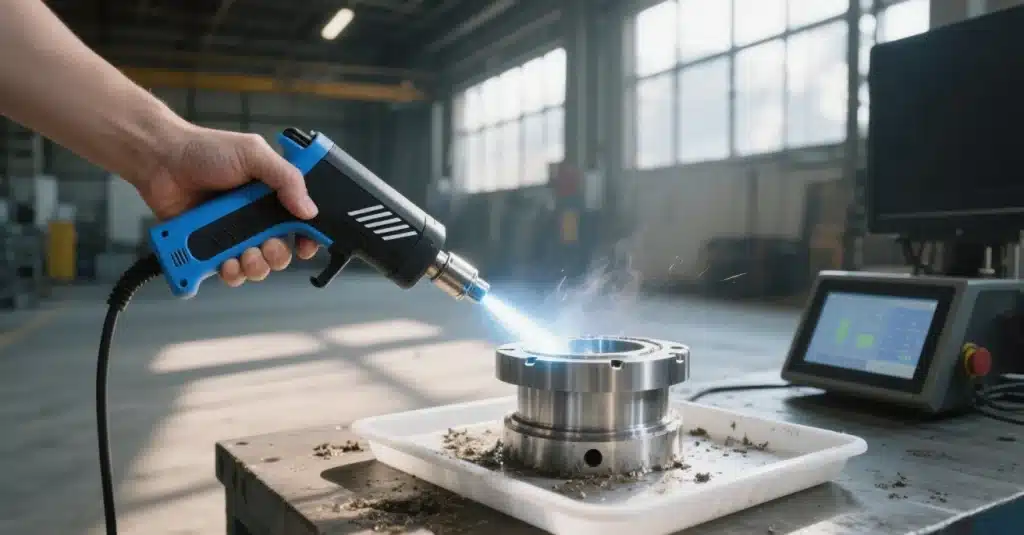
How Does Laser Cleaning Actually Work?
Understanding how a laser rust cleaner works is key to appreciating its safety and effectiveness. The process is based on a scientific principle called laser ablation, which is far more precise than it sounds.
The Ablation Threshold
Every material, from rust to solid steel, has a unique “ablation threshold“—the minimum energy required to vaporize it. Rust, paint, and other contaminants have a much lower ablation threshold than the underlying metal.
Think of it like trying to throw a ball over a wall. The laser provides just enough energy to get the “ball” (the laser beam) over the low “rust wall.” It doesn’t have enough force to clear the much higher “metal wall” behind it.
This process also has a self-limiting effect. Once the rust is gone, the clean, shiny metal surface reflects the laser beam, which prevents any further energy from being absorbed and protects the substrate from damage.
Pulsed vs. Continuous Wave (CW) Lasers
The type of laser cleaning machine for metal used is crucial for preventing heat damage.
- Pulsed Lasers (The Safe Choice): These are the gold standard for laser metal cleaning. They deliver energy in extremely short, powerful bursts. These quick pulses vaporize the rust so rapidly that significant heat doesn’t have a chance to build up in the metal. This minimizes the Heat-Affected Zone (HAZ) and prevents issues like warping.
- Continuous Wave (CW) Lasers (The Risky Choice): A CW laser delivers a constant, unbroken beam of energy. This continuous heat input significantly increases the risk of thermal damage, discoloration, and warping, especially if the operator isn’t extremely careful. While cheaper, CW lasers are generally not recommended for delicate or precision work.
Learn more about: Continuous Laser Cleaning vs. Pulse Laser Cleaning: Advanced Choices for Cleaning Equipment Parts
Disadvantages: When Laser Cleaning Goes Wrong
While generally safe, laser rust removal can cause damage if the wrong parameters are used. The risks range from obvious cosmetic flaws to hidden structural changes.
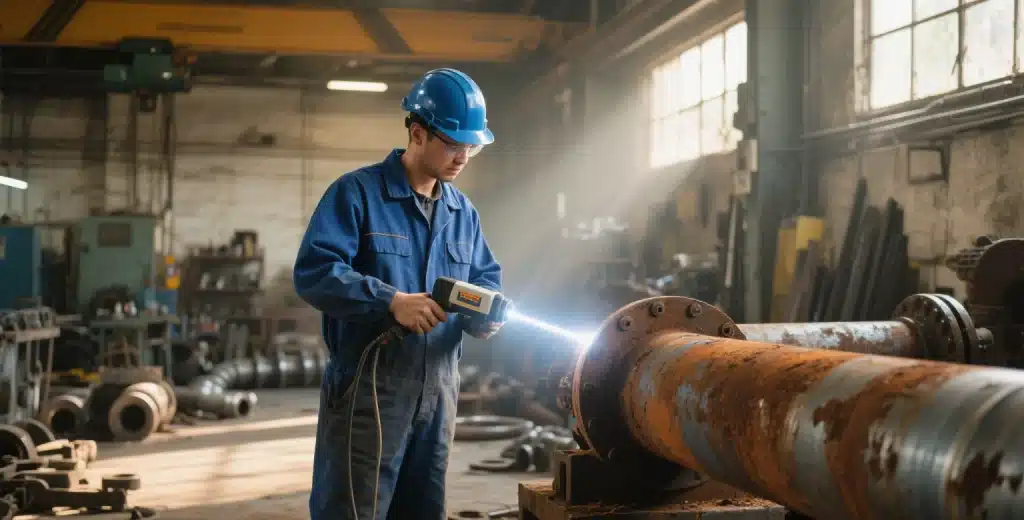
Obvious Damage: Warping, Discoloration, and Surface Melting
Using excessive power or moving the laser head too slowly can overheat the metal. This is especially true for thin sheets or delicate components. The visible consequences can include:
- Warping: The metal bends or twists out of shape.
- Discoloration: The surface takes on a burnt or rainbow-like appearance.
- Surface Melting: In extreme cases, the top layer of the metal can actually melt and re-solidify with a rough texture.
Hidden Damage: Changes to Hardness and Microstructure
A more subtle risk is the alteration of the metal’s internal structure. The rapid heating and cooling cycle from an improperly calibrated laser can act as a micro-heat treatment. For some types of steel, this can create brittle layers, while on already hardened steels, it can cause softening. This is typically a minor concern, but can be critical for high-performance parts in aerospace or automotive industries.
Laser Rust Removal vs. Traditional Methods
The debate of laser rust removal vs. sandblasting and chemical treatments often comes down to a trade-off between speed, cost, and surface preservation.
| Feature | Laser Cleaning | Sandblasting | Chemical Stripping |
| Substrate Damage | None (when done correctly) | High (removes base material) | Medium (can cause embrittlement) |
| Precision | Excellent | Poor | Poor |
| Waste | Minimal (captured fumes) | High (abrasive media, dust) | High (hazardous chemical waste) |
| Safety | High (requires eye protection) | Low (silicosis risk, requires full PPE) | Low (chemical exposure risk) |
| Initial Cost | High | Low | Medium |
| Operational Cost | Low (no consumables) | High (media, cleanup) | Medium (chemicals, disposal) |
Surface Integrity & Material Loss
- Laser: As a non-contact method, a laser rust stripper removes only the unwanted layer, preserving the original surface profile.
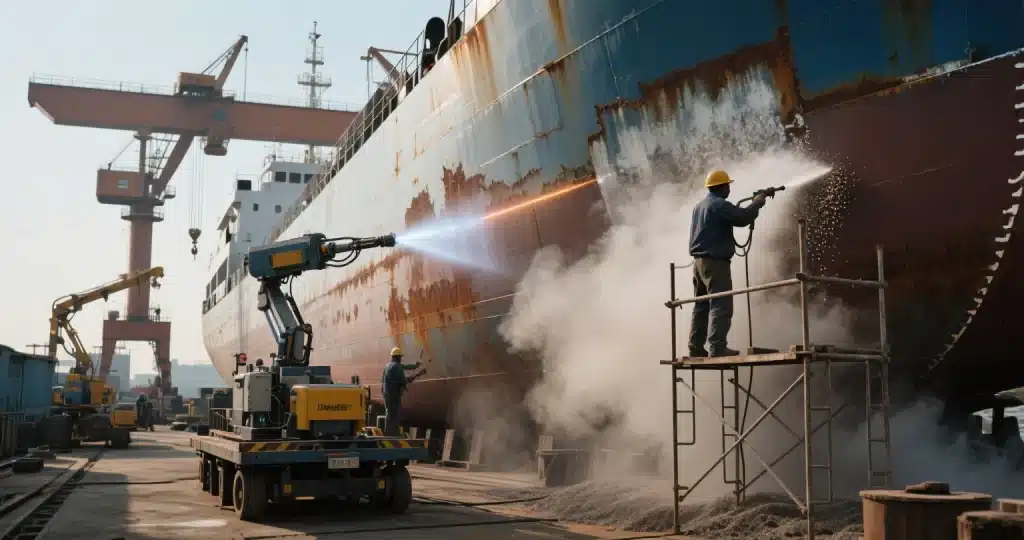
- Sandblasting: This abrasive method inherently erodes the base material along with the rust, altering dimensions and surface finish.
- Chemicals: Can cause issues like hydrogen embrittlement in steels or leave behind residues that promote future corrosion.
Precision & Control
The laser’s beam allows for unmatched precision, making it possible to clean intricate parts or specific sections without affecting adjacent areas. Sandblasting, by contrast, is a blunt instrument that is difficult to control.
Environmental & Safety Profile
Laser cleaning is considered a “green” technology. It uses no consumables and produces no secondary waste, as the vaporized fumes are captured by a filtration system. The main hazard is the laser beam, which requires proper safety goggles. Sandblasting creates hazardous airborne dust that poses a serious respiratory risk (silicosis) and requires extensive personal protective equipment (PPE).
Will Laser Rust Cleaning Machine Work on My Metal?
The effectiveness and safety of laser cleaning vary depending on the type of metal being treated.
Carbon & Stainless Steel
This is the ideal application for laser cleaning. There is a wide margin for error in the settings, and when used correctly, the process can even enhance the passive layer on stainless steel, improving its corrosion resistance.
Aluminum
Laser cleaning aluminum is effective but presents challenges. Its high reflectivity and thermal conductivity mean that the laser parameters must be carefully controlled. Interestingly, the process can sometimes increase the surface hardness and strength of the aluminum.
Cast Iron (Use With Caution!)
Laser cleaning is very effective for removing rust from cast iron. However, its structure makes it susceptible to thermal stress, which can lead to micro-cracking or warping. It can also alter the surface in a way that affects the adherence of seasoning on cookware.
Copper & Brass
These metals are difficult to clean with a laser due to their high reflectivity. The process requires very specific laser parameters, typically involving short pulses and shorter wavelengths, to avoid melting the surface.
Long-Term Effects of Laser Rust Stripper
The benefits of laser cleaning extend beyond just removing rust. The resulting surface can offer improved performance characteristics.
Enhanced Corrosion Resistance
An optimally laser-cleaned surface can be more resistant to future corrosion than one prepared by mechanical methods. Research indicates that the process can create a more stable and dense passive oxide layer on the metal.
Superior Paint & Coating Adhesion
The topic of paint adhesion after laser cleaning is a significant advantage. The laser can be used to create a specific microscopic texture, or “anchor profile,” on the surface. This controlled roughness provides an ideal base for paints and coatings to grip onto, often resulting in adhesion performance superior to the random, and sometimes damaging, profile created by sandblasting. Studies have shown that this can lead to a more durable and longer-lasting coating.

Conclusion
Ultimately, laser rust removal is a fundamentally non-damaging process when approached as a controlled surface engineering task rather than a simple cleaning job. It is not a brute-force method but a highly precise tool.
For applications demanding precision, safety, and the preservation of the base metal’s integrity, it is far superior to traditional methods like sandblasting. The key to a successful, damage-free outcome lies in using the right technology—specifically pulsed lasers—and meticulously calibrating the settings for the specific material and application.
FAQs
A: The high initial cost of the equipment and the requirement for a direct line of sight to the surface being cleaned.
A: The laser will typically remove the paint along with the rust, as it cannot differentiate between the two layers.
A: It depends. For large, simple surfaces, sandblasting is often faster. For small, intricate, or complex parts, the precision and reduced cleanup time of laser cleaning can make it more efficient overall
A: While technically possible, it’s very risky for cookware. The intense heat can warp the pan or alter the surface texture, making it difficult to season properly. It should only be done by an expert with specific parameters for cast iron.