
The industrial landscape is undergoing a massive transformation, driven by the rapid evolution of laser technology. Among the most revolutionary tools in modern manufacturing is the fiber laser welder. As industries strive for greater precision, faster production cycles, and reduced operational costs, the question often arises: how does a fiber laser welder work?
In this comprehensive 2026 guide, we will dive deep into the science behind fiber laser welding. Whether you are an engineer looking to optimize your production line or a business owner considering an upgrade from traditional TIG or MIG welding, understanding the underlying mechanisms of fiber lasers is crucial. From the quantum physics of stimulated emission to the fluid dynamics of the “keyhole” effect, here is everything you need to know about the science of fiber laser welding.
What Is a Fiber Laser? (Definition and Core Components)
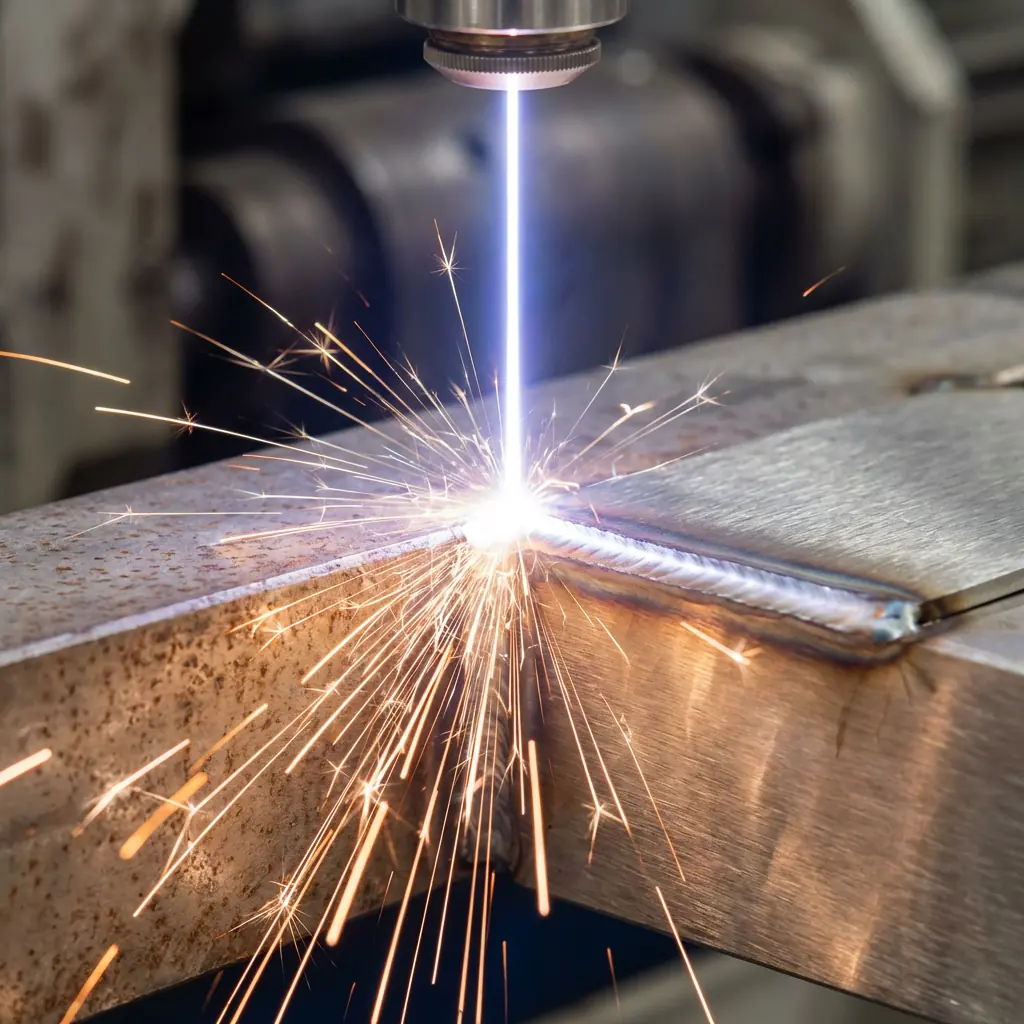
At its simplest level, a fiber laser is a type of solid-state laser where the “active gain medium”—the material that generates the laser light—is an optical fiber doped with rare-earth elements. In industrial welding, the most common dopant is ytterbium, which produces a high-powered beam in the near-infrared spectrum (typically around 1070 nm).
Unlike CO2 lasers, which use a gas mixture and mirrors to generate and direct the beam, fiber lasers create the beam directly within a flexible fiber. This architecture allows for a more compact design, higher energy efficiency, and a beam quality that is far superior to older technologies. Because the light is already inside a fiber, it can be easily delivered to the workpiece via a delivery cable, making it ideal for integration into robotic arms or handheld fiber laser welders.
The Core Components of a Fiber Laser Welder
To understand how a fiber laser welder works, we must first look at the hardware that makes it possible. A modern fiber laser welding system consists of several sophisticated subsystems working in perfect synchronization.
Laser Source (Ytterbium-doped optical fiber)
The heart of the machine is the laser source. Inside this unit, several kilometers of optical fiber are coiled. This fiber isn’t your standard telecommunications cable; it is “doped” with ytterbium ions. When energy is pumped into this fiber, the ytterbium ions become excited and release photons, creating the laser beam. The fiber itself acts as the resonant cavity, eliminating the need for complex mirror alignments found in traditional lasers.
Pump Diodes (Energy source)
If the ytterbium fiber is the heart, the pump diodes are the fuel. These are high-power semiconductor devices that emit light into the cladding of the doped fiber. This “pumping” process is what excites the ytterbium ions. Modern 2026-era pump diodes are incredibly efficient, converting over 45% of electrical energy into light, which is one reason why fiber lasers are so much more energy-efficient than traditional welding equipment.
Optical Fiber Delivery System (Transmission)
One of the greatest advantages of a fiber laser is its delivery system. The generated laser light stays trapped within a flexible “delivery fiber” via total internal reflection. This allows the laser source to be located several meters away from the actual welding point. The delivery fiber is rugged and can be manipulated by robotic systems or handled by a human operator without losing beam quality.
The Welding Head (Focusing and gas delivery)
The welding head is where the “magic” happens. It contains a series of collimating and focusing lenses that take the diverging light from the fiber and concentrate it into a microscopic spot—often less than 0.1mm in diameter. The head also manages the delivery of shielding gas (such as Argon or Nitrogen) to protect the molten pool from oxidation, and in some cases, it includes a “wobble” mechanism to oscillate the beam for better gap-bridging.
The Step-by-Step Science of Fiber Laser Welding
Now that we know the components, let’s look at the actual process. The transformation of electricity into a high-strength weld happens in four distinct phases.
Phase 1: Generation of the Laser Beam (Stimulated Emission)
The process begins with stimulated emission. Pump diodes inject light into the ytterbium-doped fiber. As the ytterbium atoms absorb this energy, their electrons jump to a higher energy state. When a photon of a specific frequency passes by these excited atoms, it “stimulates” them to release their stored energy as a second photon that is identical in frequency, phase, and direction. This chain reaction amplifies the light into a coherent, monochromatic laser beam.
Phase 2: Beam Focusing and High-Intensity Energy
Once the beam leaves the delivery fiber, it enters the welding head. Here, the lenses focus the beam to a point of extreme power density. We are talking about millions of watts per square centimeter. This concentration of energy is what allows the fiber laser to melt metal instantly, whereas a traditional arc welder spreads heat over a much larger area.
Phase 3: Material Interaction (Absorption and Melting)
When the focused beam hits the metal surface, the material’s electrons absorb the photons’ energy. This energy is converted into heat almost instantaneously. Because fiber lasers operate at a wavelength of ~1.07 µm, they are highly absorbed by most metals, including reflective materials like aluminum and copper, which were historically difficult to weld with CO2 lasers.
Phase 4: Keyhole Formation and Coalescence
As the temperature exceeds the metal’s boiling point, a small amount of metal vaporizes. The pressure from this vapor creates a narrow, deep cavity known as a “keyhole.” The laser beam travels down this keyhole, allowing it to melt the metal through the entire thickness of the joint. As the laser moves forward, the molten metal flows around the keyhole and solidifies behind it, creating a deep, narrow, and incredibly strong weld. This is often combined with other functions in versatile machines like the 3-in-1 laser welding, cleaning, and cutting machine.
Why Fiber Lasers Are Superior to Traditional Welding Methods
The science of fiber laser welding translates directly into tangible business benefits. Here is why the industry is moving away from MIG/TIG and toward fiber.
- Precision: The small spot size allows for intricate welds with minimal distortion. You can weld thin foils or thick plates with the same level of control.
- Speed: Fiber laser welding is typically 4 to 10 times faster than TIG welding. This massive increase in throughput is the primary driver for ROI in B2B environments.
- Minimal Heat-Affected Zone (HAZ): Because the heat is so localized and the process is so fast, the surrounding material remains cool. This prevents warping, discoloration, and loss of structural integrity in sensitive alloys.
- Energy Efficiency: Fiber lasers consume significantly less power than CO2 or arc welding systems, leading to lower utility bills and a smaller carbon footprint.
- Lower Maintenance: With no mirrors to align and pump diodes lasting over 100,000 hours, downtime is virtually eliminated.
Handheld vs. Robotic Fiber Laser Welders: How the Mechanisms Differ
While the internal science is the same, the application methods differ based on the needs of the workshop.
Robotic Fiber Laser Welders are used for high-volume, repetitive tasks. They offer the highest level of consistency and can operate in environments that are dangerous for humans. They often utilize “remote welding” where mirrors in the head steer the beam at lightning speeds.
Handheld Fiber Laser Welders, on the other hand, have democratized this technology. They allow a manual operator to achieve “TIG-like” quality with “MIG-like” ease. Modern handheld units are equipped with safety sensors that ensure the laser only fires when in contact with the workpiece, making them safe for a wide range of fabrication shops.
Applications Across Industries
Fiber laser welding is no longer a niche technology; it is a standard in several high-stakes industries:
- Automotive: Welding battery packs for EVs, door frames, and exhaust systems. The speed and strength of laser welds are essential for vehicle safety and weight reduction.
- Aerospace: Joining lightweight alloys and titanium components where structural integrity and minimal HAZ are non-negotiable.
- Electronics: Precise welding of micro-connectors and sensors without damaging delicate internal components.
- Medical Devices: Creating hermetic seals on pacemakers and surgical instruments where biocompatibility and cleanliness are paramount. If cleaning is required before welding, many shops utilize a pulse laser cleaning machine to ensure a pristine surface.
Frequently Asked Questions (FAQ)
Q: Is fiber laser welding safe for operators?
A: Yes, provided that proper safety protocols are followed. Operators must wear laser-safe eyewear (OD7+) and work in a light-tight enclosure or designated laser-safe area. Most modern machines include built-in safety interlocks.
Q: Can fiber lasers weld dissimilar metals?
A: One of the strengths of fiber laser welding is its ability to join dissimilar metals, such as copper to stainless steel, which is often impossible with traditional methods.
Q: What is the maximum thickness a fiber laser can weld?
A: This depends on the power of the laser source. A 1.5kW source can typically weld up to 4mm of stainless steel, while higher-power 6kW+ systems can handle 20mm or more.
Q: How does the “wobble” function work?
A: The wobble function uses oscillating mirrors in the welding head to move the beam in patterns (circles, lines, eights). This widens the weld bead and helps bridge gaps in poorly fitted parts.
Conclusion: The Future of Industrial Joining
Understanding how a fiber laser welder works reveals why it has become the gold standard for industrial joining. By leveraging the principles of fiber optics and stimulated emission, these machines provide a level of speed, precision, and efficiency that was once unthinkable. As we move through 2026, the adoption of fiber laser technology will only accelerate, separating the leaders in manufacturing from the rest.
At Laser Scheme, we specialize in providing cutting-edge fiber laser solutions tailored to your specific industrial needs. From high-power robotic systems to versatile handheld units, we help you harness the science of light to build better products. Explore our full range of fiber welding solutions today and take your production to the next level.