In the evolving landscape of industrial surface preparation, the battle between traditional methods and emerging technologies has never been more intense. For decades, sandblasting (abrasive blasting) was the undisputed king of rust removal and surface cleaning. However, as we move through 2026, the industrial sector is witnessing a paradigm shift. Sustainability, precision, and operational efficiency are no longer just buzzwords; they are the benchmarks of a successful manufacturing or restoration business.
Enter laser cleaning—a technology once reserved for high-end aerospace labs that has now become accessible for workshops and production lines globally. But is it truly better than the tried-and-true sandblaster? In this detailed 2026 comparison, we will dissect the technical principles, costs, and environmental impacts of both methods to help you decide which is the right investment for your operation.
What is Sandblasting?
Sandblasting, technically known as abrasive blasting, is a process that uses compressed air to propel a stream of abrasive material against a surface. The goal is to remove contaminants, smooth a rough surface, or roughen a smooth surface. While “sand” was the original medium, health concerns regarding silicosis have led to a diversification of media. In 2026, the selection of media is dictated by both the substrate material and increasingly strict environmental disposal laws.
Common Abrasive Media & Their Applications:
- Silica Sand: Historically the most common, but now banned in many jurisdictions due to the risk of silicosis. It is cheap but extremely hazardous.
- Garnet: A versatile, semi-precious mineral. It is the modern standard for heavy-duty metal cleaning. It is faster than sand and produces less dust, but it is significantly more expensive.
- Glass Beads: Spherical particles used for “honing.” They clean a surface without removing the underlying metal, making them popular for automotive parts and stainless steel finishing. However, they lack the “bite” needed for heavy rust.
- Steel Grit and Shot: Angular (grit) or spherical (shot) steel particles. They are highly recyclable but require a closed-loop blast cabinet. They are the preferred choice for structural steel fabrication where a specific surface profile is required for coating.
- Aluminum Oxide: An extremely hard, angular abrasive used for fast cutting on hard metals. It is often used in aerospace and medical manufacturing but has a high cost per pound.
- Soda Blasting: Uses sodium bicarbonate. It is non-destructive and water-soluble, making it ideal for cleaning engine components or restoring historic wood without damage.
- Dry Ice Blasting: A unique method where CO2 pellets freeze the contaminant, causing it to crack and fall off. It leaves no secondary waste but requires a constant, expensive supply of dry ice and high-volume air.
The core principle of sandblasting is kinetic energy (Ek = ½mv²). The impact of the particles physically “chisels” away the coating, rust, or oxide layer. This mechanical impact inevitably transfers energy to the substrate. On a microscopic level, this causes the surface to deform, creating a “peened” or “profiled” texture. While this is beneficial for paint adhesion, it can be catastrophic for high-tolerance engineering components where surface integrity is paramount.
What is Laser Cleaning?
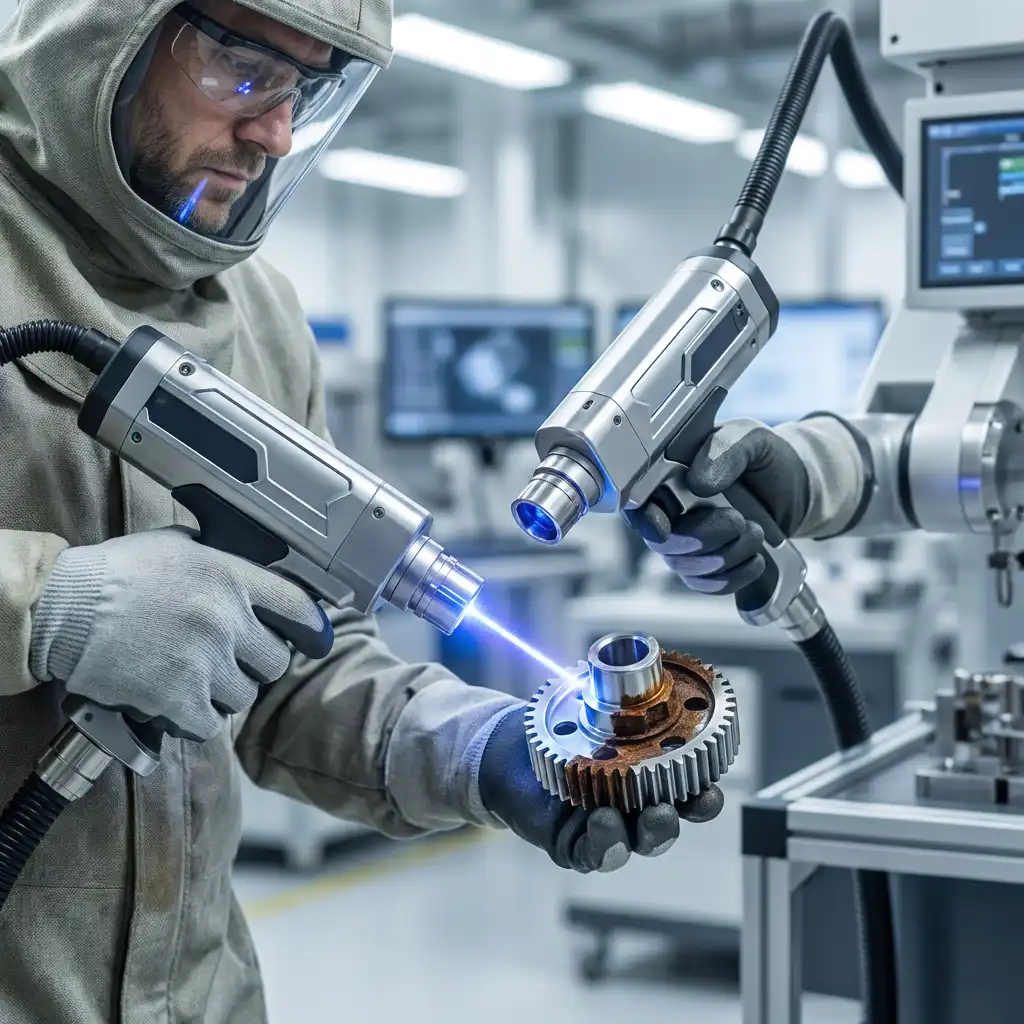
Laser cleaning is a non-contact, non-abrasive process that uses high-energy laser pulses to remove contaminants from a substrate. This process is known as laser ablation. Unlike sandblasting, which uses physical mass to strike a surface, laser cleaning uses electromagnetic radiation to interact with the material at a molecular level.
The Physics of Laser Ablation:
When a laser beam strikes a surface, several complex interactions occur within nanoseconds:
- Absorption: The contaminant layer absorbs the laser energy. Most metals reflect infrared light, while oxides, rust, and paints absorb it. This disparity is why the laser can “clean” without “cutting.”
- Phase Explosion: The temperature of the contaminant rises so rapidly that it bypasses the liquid phase and expands as a plasma gas.
- Photomechanical Shock: The rapid expansion creates a microscopic pressure wave that physically ejects any unvaporized particles from the surface.
- Plasma Shielding: In high-power systems, a thin layer of plasma forms above the surface, which helps regulate the energy transfer, ensuring the substrate remains below its melting point.
Pulse vs. CW Laser Cleaning:
In 2026, the distinction between laser types is critical for B2B buyers looking to optimize their workflow:
- Pulse Laser Cleaning: Often called “cold cleaning.” These machines emit short bursts (nanoseconds) of high-peak power. Because the pulse is so short, there is virtually no time for heat to conduct into the metal. It is the gold standard for aerospace, high-precision molds, and sensitive electronics. Explore our Pulse Laser Cleaning Machine for detailed technical specs.
- Continuous Wave (CW) Laser Cleaning: These machines output a steady stream of laser light. They are the “workhorses” for heavy industry. While they produce more heat, they are significantly more cost-effective for removing thick layers of scale or marine growth on large steel structures.
For shops that need flexibility, the 3-in-1 Laser Welding Cleaning Cutting Machine has emerged as a favorite in 2026, offering a versatile platform for fabrication and maintenance in a single footprint.
Key Comparison Factors in 2026
1. Precision and Substrate Integrity: Laser’s Winning Edge
The most profound technical differentiator is the effect on the underlying material. In the world of high-value manufacturing, Heat-Affected Zones (HAZ) and dimensional stability are paramount. Sandblasting is a mechanical assault. No matter how “fine” the media, the impact creates microscopic pits and peaks. This can be problematic in several ways:
- Work Hardening: The repeated impact of blast media can change the hardness of a metal’s surface, affecting its fatigue life.
- Contaminant Inclusion: Small particles of blast media can become embedded in the soft metal surface (like aluminum or bronze), leading to future corrosion issues.
- Warping: On thin sheets of metal, the compressive stress of sandblasting can cause the part to twist or warp beyond its tolerances.
In contrast, Laser Cleaning is a selective process. By adjusting the laser parameters (frequency, pulse width, and energy), operators can target a specific coating while the substrate reflects the beam. This “cold” cleaning ensures that the metallographic structure of the material remains unchanged. In 2026, many aerospace and nuclear facilities have mandated laser cleaning for these very reasons—ensuring that every part remains within its original engineering specifications.
2. Speed and Efficiency: Redefining Throughput
While a large-diameter sandblasting nozzle can strip a square meter of rust very quickly, the total cycle time of a project often favors the laser. Let’s compare the steps involved in a typical industrial part cleaning project:
| Step | Sandblasting Method | Laser Cleaning Method |
|---|---|---|
| Preparation | 1-2 hours (Masking, taping, sealing sensitive electronics). | 5 minutes (Check safety boundaries). |
| Cleaning | Fast (3-5 m²/hr for heavy scale). | Moderate (1-2 m²/hr for high-precision pulse). |
| Post-Cleaning | 1 hour (Blowing off dust, media recovery). | Zero (No secondary cleanup). |
| Waste Disposal | Ongoing (Managing tons of contaminated media). | Minimal (Filter bags changed weekly). |
In a production line environment, the “instant-on, instant-off” nature of the laser means it can be integrated directly into an automated cell. Sandblasting, with its mess and noise, must always be isolated in a dedicated “blast room,” creating a logistical bottleneck.
3. Environmental Compliance and Regulatory Pressures
In 2026, the environmental footprint of a factory is scrutinized more than ever by regulators like the EPA and OSHA. Sandblasting is increasingly difficult to justify for three reasons:
- Air Quality: Dust management requires massive, energy-intensive ventilation systems and carries a high risk of air pollution.
- Secondary Waste: For every kilogram of rust removed, sandblasting produces 20-50 kilograms of waste media. If that waste is contaminated with heavy metals (like lead or chromium), the disposal costs can exceed the labor costs of the project.
- Resource Consumption: Sandblasting requires thousands of liters of clean water or massive amounts of compressed air. Laser cleaning uses only a small amount of electricity, which can be powered by renewable sources, supporting corporate “Net Zero” goals.
4. Safety and Labor Health
Modern labor markets are increasingly safety-conscious. Finding workers willing to spend 8 hours a day in a blast suit is becoming impossible. Silicosis and noise-induced hearing loss remain major liability risks for companies using abrasive blasting. Laser cleaning, while requiring laser safety protocols (NOHD zones and OD7+ eyewear), is a much more ergonomic and “cleaner” job. It allows workers to focus on quality control rather than struggling with a heavy blast hose, significantly reducing workplace fatigue and turnover.
5. Operational Costs: The 2026 Cost Breakdown
The financial debate between laser and sandblasting is no longer just about the purchase price. It’s about Total Cost of Ownership (TCO).
Consider a typical 2000W Laser Cleaning system versus a high-end portable sandblaster. While the sandblaster costs $10,000 and the laser costs $30,000, the operating costs diverge immediately. The sandblaster consumes $50-$100 of media per hour, plus the maintenance on valves, nozzles, and hoses. The laser’s only operational cost is electricity—typically less than $1.00 per hour. Over a 2,000-hour work year, the savings on media alone can easily cover the price difference of the machine twice over.
When to Choose Sandblasting?
Despite the advantages of lasers, sandblasting remains the better choice in specific scenarios:
- Large-Scale Structural Steel: For bridges, ship hulls, and massive oil tanks, the sheer volume of material often makes high-capacity grit blasting more economical.
- Coating Adhesion: Some industrial coatings require a specific “anchor profile” (roughness) to stick. Since lasers don’t roughen the surface, sandblasting is necessary to create that texture.
- Concrete and Masonry: Cleaning large buildings or sidewalks is still dominated by abrasive or water blasting due to the porous nature of the material.
When to Choose Laser Cleaning?
Laser cleaning is the superior choice for:
- Precision Engineering: Aerospace components, turbine blades, and high-tolerance engine parts.
- Mold Cleaning: Cleaning injection molds while they are still in the machine, without causing wear that changes the part dimensions.
- Selective Cleaning: Removing paint from a specific area for welding or inspection without affecting the surrounding coating.
- Medical and Food Industry: Where chemical-free, sterile, and dust-free cleaning is mandatory.
- Automotive Restoration: Cleaning classic car panels without the risk of warping or “pitting” the metal.
ROI Analysis: Long-term Savings of Laser Cleaning
If you are a B2B decision-maker, the return on investment (ROI) is the ultimate metric. A high-quality laser cleaning system might cost $15,000 to $50,000 depending on wattage and pulse technology. A sandblasting setup might be $5,000 to $10,000.
However, when you factor in:
- Zero Consumable Costs: Savings of $5,000-$10,000 per year on media.
- Labor Reduction: 50% faster total process time (including cleanup).
- Waste Disposal Savings: No hazardous media disposal fees.
- Maintenance: Lasers have no moving parts in the cleaning head to wear out.
Most industrial users find the break-even point for a laser cleaning machine is between 12 to 18 months. Beyond that, the machine generates pure profit compared to the ongoing drain of abrasive blasting.
The Verdict: Which Should You Invest In?
In 2026, the industrial cleaning market has split into two distinct sectors. For heavy-duty, large-scale, low-precision structural work (like bridges, ships, and infrastructure), sandblasting remains the most practical tool. It provides the high-volume stripping power and surface profiling necessary for heavy-duty coatings.
However, for virtually every other application—from aerospace maintenance and automotive restoration to high-tech manufacturing and delicate mold cleaning—laser cleaning is the undisputed champion. Its combination of non-destructive precision, zero-waste operation, and massive long-term ROI makes it the smart choice for businesses aiming to modernize their surface preparation.
At laserscheme.com, we are at the forefront of this industrial transition. We provide cutting-edge solutions that solve the biggest pain points of traditional abrasive methods. Whether you need the absolute surgical precision of our Pulse Laser Cleaning Machine or the extreme flexibility of our 3-in-1 Laser Welding Cleaning Cutting Machine, our technology is designed to make your operations safer, cleaner, and more profitable.
The question is no longer “Which is better?” but rather “How soon can you make the switch to laser technology?”
Conclusion: Why Laser Cleaning is the Future
The industrial sector of 2026 is uncompromising in its demand for efficiency and environmental responsibility. Sandblasting, while still a functional tool for brute-force tasks, increasingly feels like a relic of a previous era—one defined by waste, hazardous dust, and high labor overhead. Laser technology, with its “light-based” precision and eco-friendly footprint, is the definitive future of industrial surface preparation.
By transitioning to laser cleaning, you are not just buying a machine—you are investing in a cleaner workshop, a safer workforce, and a more sustainable business model. The future of cleaning is bright, precise, and powered by lasers.